
Responsible AI is the organizational commitment to deploying artificial intelligence in ways that are transparent, accurate, fair, protective of privacy, accountable, secure, and considerate of broader human and environmental consequences. For mid-market organizations, responsible AI is not an ethical aspiration reserved for Big Tech companies — it is a practical governance obligation that affects client trust, legal standing, and organizational reputation.
This guide explains what responsible AI means in operational terms, what each of the six dimensions requires in practice, and how to build responsible AI commitments into your AI governance framework from the start.
Why Responsible AI Is a Business Risk Issue, Not Just an Ethics Issue
The framing of AI responsibility as a values question — “do we care enough to use AI ethically?” — misses the practical business case.
Consider three scenarios that mid-market organizations encounter regularly:
Scenario 1: A client asks directly: “Does your firm use AI? How is client data protected?” An organization without a documented responsible AI position has no coherent answer. An organization with one does.
Scenario 2: An AI system used for shortlisting job candidates systematically produces results that favor one demographic over another, without anyone in the organization noticing. Employment law applies. Reputational damage is real.
Scenario 3: An AI tool produces a confident, factually wrong answer to a client question. The employee trusted it without verifying. The client acted on it. The error created a commercial dispute.
In all three scenarios, the responsible AI dimension that was not addressed — transparency, fairness, accuracy — is not an abstract ethics failure. It is a business incident with real consequences.
Responsible AI governance does not require a separate ethics committee or a new budget line. It requires that the six dimensions below are explicitly addressed within the AI governance framework already being built.
The 7 Dimensions of Responsible AI
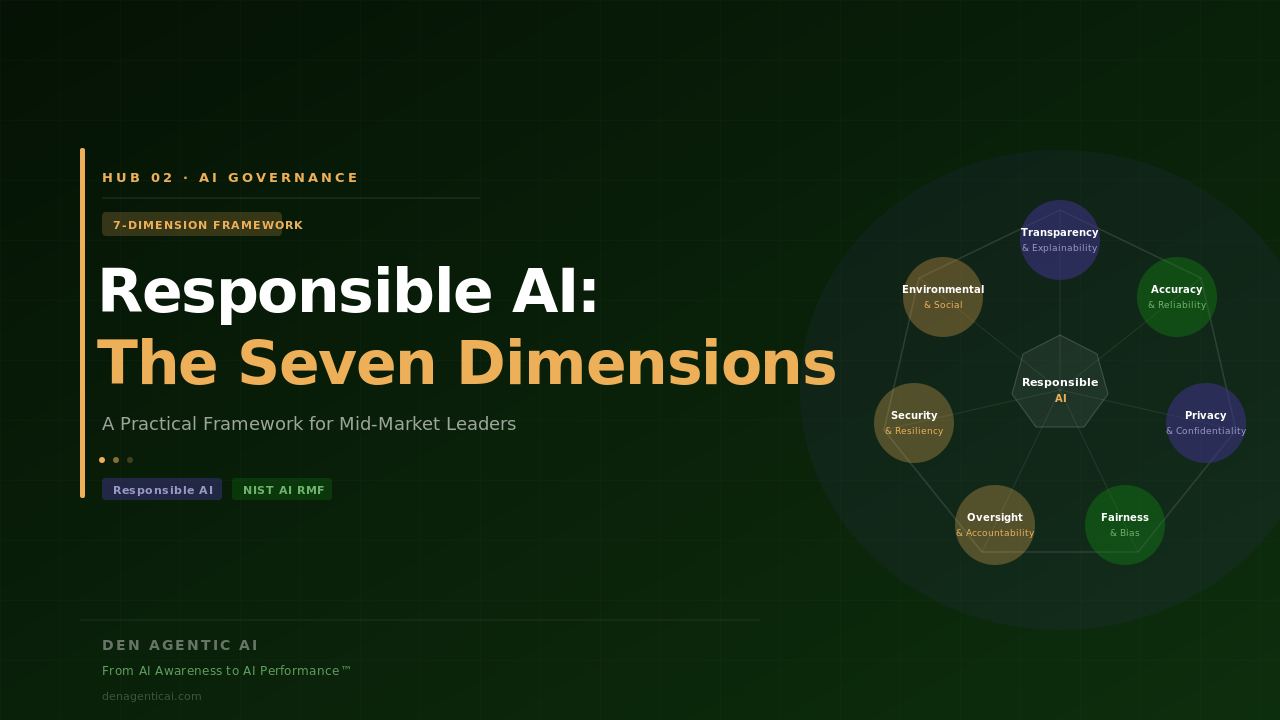
Responsible AI adoption — aligned with the NIST AI Risk Management Framework’s trustworthiness criteria — requires organizational commitment across seven dimensions, each addressing a distinct category of risk and harm.
Dimension 1: Transparency & Explainability
What it means: Being open about when and how AI is used — with employees, clients, and stakeholders. This includes not just disclosure (telling people AI was involved) but explainability — being able to describe, at least in general terms, how an AI system reached a particular output or decision.
Why it matters: Trust in AI output is conditional on honesty about its source. Clients who discover that AI was involved in their deliverables without disclosure tend to react worse than clients who were told upfront. Explainability is increasingly expected — and in some regulatory contexts required — particularly when AI influences decisions about individuals.
What it requires in practice:
- Any AI-generated content shared with clients is disclosed as AI-assisted (not necessarily attributed to a specific tool — disclosing the assistance is sufficient)
- Any AI-mediated client interaction (chatbot, automated response) is identifiable as AI — not presented as a human interaction
- The organization is prepared to answer client questions about AI use with a clear, documented policy position
- Staff know they should not claim AI-generated work as entirely their own without attribution
- For Tier 3 initiatives influencing decisions about individuals (hiring, credit, service eligibility), the organization can explain in plain language what factors the AI system considers — even if the full model is proprietary
Governance control: Add a transparency disclosure requirement to the AI use policy and the Tier 2 and Tier 3 output review checklist. For Tier 3 initiatives, document the decision logic in the AI Initiative Canvas.
Dimension 2: Accuracy & Reliability
What it means: AI outputs that reach clients, influence decisions, or affect operational processes must be verified for factual accuracy before use.
Why it matters: AI language models generate plausible-sounding content with equal confidence regardless of whether the content is accurate. This is a fundamental characteristic of the technology, not a flaw that will be eliminated by the next model release.
What it requires in practice:
- AI outputs in Tier 2 and Tier 3 contexts are treated as drafts requiring human verification — not as final answers
- Employees are trained to identify high-hallucination-risk contexts: statistical claims, specific dates, citations, legal interpretations, product specifications
- Output review is documented (reviewer signs off that the content was verified before sending)
- Quality KPIs track revision rates on AI-generated drafts to identify tools or use cases with poor reliability
Governance control: Accuracy verification is part of the Tier 2 and Tier 3 output review procedure. The AI Governance Owner tracks error rates in the Governance Metrics Dashboard.
Dimension 3: Data Privacy & Confidentiality
What it means: The organization’s confidential data — client information, employee data, financial data, proprietary business information — is protected from unauthorized exposure through AI systems.
Why it matters: Consumer AI tools may use inputs for model training or transmit data to third-party servers. Client contracts may include data handling clauses that extend to AI tool usage. Regulatory frameworks (GDPR, PIPEDA, HIPAA) may apply to personal data processed through AI systems.
What it requires in practice:
- A written data classification rule defining which categories of data cannot enter any AI tool without explicit approval
- Data processing agreements reviewed with enterprise AI tool vendors before deployment
- Client contract terms reviewed for AI-relevant data handling clauses
- Employee training on which data is prohibited in AI tools — with concrete examples, not just abstract categories
Governance control: The data classification rule is the primary control. It must be reviewed when client contracts are renewed and when new AI tools are approved.
Dimension 4: Bias & Fairness
What it means: AI systems used in decisions affecting people — hiring, performance evaluation, client treatment, credit or pricing decisions — are assessed for systematic bias before deployment and monitored for it afterward.
Why it matters: AI systems trained on historical data inherit historical biases. An AI hiring tool that was trained on historical hires from a predominantly homogeneous organization will systematically favor candidates who resemble those historical hires — even if the organization has no discriminatory intent. The intent does not matter; the outcome does.
What it requires in practice:
- Any AI system that influences decisions affecting individuals (hiring, performance, client terms, service eligibility) requires a bias review before deployment
- Bias review includes: what training data was used? What decisions does the system influence? What populations could be systematically disadvantaged?
- Post-deployment monitoring includes periodic review of outcome distributions across relevant demographic groups
- Where systematic bias is identified, the AI system must be corrected or removed
Governance control: Bias review is a mandatory pre-deployment step for any Tier 3 initiative involving decisions about individuals. Document the review findings in the AI Initiative Canvas.
Dimension 5: Human Oversight & Accountability
What it means: A named human being must be accountable for every AI initiative — for its performance, its governance compliance, and its incident response. AI systems are not accountable entities. People are.
Why it matters: Organizations that deploy AI without clear human accountability create environments where problems go unaddressed because “the AI did it.” This is both practically dangerous and legally untenable in most regulatory contexts.
What it requires in practice:
- Every AI initiative has a named AI initiative owner (typically the business sponsor who requested and benefits from the initiative)
- The AI initiative owner is accountable for ensuring the initiative operates within its defined governance tier
- The AI Governance Owner is accountable for the governance framework overall
- Accountability is documented in writing — not assumed by role
Governance control: Named initiative owner is required in the AI Initiative Canvas and in the Risk Tiering Register. Accountability is explicit, not implied.
Dimension 6: Security & Resiliency
What it means: AI systems — particularly those with access to organizational data, external APIs, or autonomous action capabilities — are attack surfaces. Responsible AI adoption includes protecting AI systems from adversarial manipulation, unintended misuse, and failure modes that could expose organizational or client data.
Why it matters: The NIST AI RMF explicitly identifies security and resiliency as a core trustworthiness dimension. AI systems face threats that traditional software does not: prompt injection attacks (where malicious inputs hijack an AI system’s behavior), data poisoning (corrupting the training or fine-tuning data that shapes model outputs), adversarial inputs designed to cause systematic misclassification, and indirect prompt injection through external content that an AI agent retrieves and processes. As AI agents gain access to email, files, databases, and external services, the blast radius of a compromised AI system grows significantly.
What it requires in practice:
- AI tools with access to sensitive data, external systems, or the ability to take autonomous actions (Tier 2 and Tier 3) should be assessed for adversarial manipulation risks before deployment
- Employees should be trained to recognize prompt injection attempts — particularly in AI tools that process external content (emails, web pages, uploaded documents)
- AI systems should fail safely: when an AI tool produces unexpected or anomalous output, the default behavior should be to stop and escalate, not to proceed
- Access permissions for AI systems (especially agentic AI) should follow the principle of least privilege — the AI agent should have access only to the systems and data it needs for its defined task, no more
- AI vendor security practices should be reviewed as part of the tool approval process (Approved Tools Register), particularly for tools handling confidential data
Governance control: Security review is part of the Tier 2 and Tier 3 tool approval process. For agentic AI systems (Tier 3 by default), a formal security assessment documenting access boundaries, failure modes, and adversarial risk is required before deployment.
Dimension 7: Environmental & Social Considerations
What it means: Organizations should be aware of the resource consumption of large AI model usage and should not deploy AI in ways that create social harm — including displacing employees without adequate support and communication.
Why it matters: This dimension is often treated as irrelevant for mid-market organizations — left to the AI vendors and regulators to manage. But two aspects are directly relevant at the organizational level: workforce impact management and client community impact.
What it requires in practice:
- Any AI deployment that materially changes job roles or eliminates tasks previously performed by employees should be accompanied by a workforce communication plan and transition support
- The AI change management process (Service 4 and the DEN AI Skills Taxonomy) should be triggered alongside, not after, Tier 2 and Tier 3 deployments
- Organizations should have a position on AI and employment that can be communicated to employees before deployments go live — not in response to concerns after the fact
Governance control: The Leadership Communication Playbook (part of the AI Governance Operating Manual) should address the workforce and community impact of each deployment proactively.
How to Embed Responsible AI in Your Governance Framework
Responsible AI is not a separate programme — it is a set of requirements embedded within the governance controls you are already building.
| Dimension | Where it lives in governance |
|---|---|
| Transparency & Explainability | AI use policy + Tier 2/3 output review checklist + decision logic documented in AI Initiative Canvas for Tier 3 |
| Accuracy & Reliability | Tier 2/3 output review procedure + quality KPIs in metrics dashboard |
| Data Privacy | Data classification rule + vendor data processing agreements |
| Bias & Fairness | Pre-deployment risk assessment for Tier 3 initiatives affecting individuals |
| Human Oversight | Named accountability in AI Initiative Canvas + Risk Tiering Register |
| Security & Resiliency | Security review in Tier 2/3 tool approval; least-privilege access policy for agentic systems; adversarial risk assessment for Tier 3 |
| Environmental & Social | Leadership Communication Playbook + workforce change management process |
→ How to build the governance framework that embeds these controls →
→ How the DEN Risk Tiering Model determines which controls apply →
→ Take the free Governance Assessment to identify which responsible AI gaps exist today →
→ Return to Hub 2: The Complete Guide to AI Governance →
Frequently Asked Questions
Q: What does responsible AI mean for a business? Responsible AI means deploying artificial intelligence in ways that are transparent with clients and employees, accurate in their outputs, protective of private data, fair in decisions affecting people, clearly accountable to named individuals, and mindful of workforce and social impact. For a mid-market organization, these commitments are operationalized through the AI governance framework — not through a separate ethics programme.
Q: What are the dimensions of responsible AI? The seven dimensions are: (1) Transparency & Explainability — disclosure of AI use and the ability to explain how AI-influenced decisions were made; (2) Accuracy & Reliability — verification of AI outputs before use; (3) Data Privacy & Confidentiality — protection of restricted data categories; (4) Bias & Fairness — pre-deployment review of AI systems that influence decisions about people; (5) Human Oversight & Accountability — named human accountability for every AI initiative; (6) Security & Resiliency — protection of AI systems from adversarial manipulation and failure modes; (7) Environmental & Social Considerations — workforce impact management and community considerations. These seven dimensions align with the NIST AI Risk Management Framework’s trustworthiness criteria, adapted for mid-market operational practice.
Q: Is responsible AI required by law in the US and Canada? No single federal AI law governs responsible AI in the US or Canada — but the regulatory exposure is real and growing from multiple directions. In the US, the NIST AI Risk Management Framework (AI RMF) is the de facto voluntary standard; organizations using it can demonstrate structured AI governance to clients, auditors, and regulators. More directly, the EEOC and CFPB have both issued guidance making clear that existing law (Title VII, the Equal Credit Opportunity Act, the Fair Housing Act) applies to AI-driven decisions — meaning an AI hiring or credit tool that produces discriminatory outcomes creates liability under law that is already in force. At the state level, New York City’s Local Law 144 (bias audits for AI in hiring) and Colorado’s revised ADMT law (effective January 2027) are the leading examples of jurisdiction-specific AI obligations, with more states following. In Canada, PIPEDA governs personal data used in AI systems, with penalties up to C$100,000; Quebec’s Law 25 imposes additional obligations around automated decision-making with significant effects on individuals; and sector regulators (OSFI for financial services, Health Canada) have issued AI-relevant guidance. The through-line: AI systems that influence decisions about people — hiring, credit, services, insurance — are already regulated by existing civil rights, consumer protection, and privacy law. Responsible AI governance operationalizes compliance with the law as it exists today.
Q: How does responsible AI relate to ESG? Responsible AI is increasingly a component of ESG (Environmental, Social, Governance) reporting — particularly in the G (Governance) and S (Social) dimensions. Organizations with documented responsible AI frameworks are better positioned for ESG disclosure requirements and investor scrutiny of AI practices.
Q: Which responsible AI dimensions are most commonly missing in mid-market organizations? Human Oversight & Accountability is the most commonly absent dimension: AI initiatives are deployed without a named initiative owner, and when something goes wrong, accountability is unclear. The second most commonly missing dimension is Transparency — organizations using AI in client-facing work often have no documented position on AI disclosure. Security & Resiliency is the most commonly underestimated — organizations treat AI security as an IT concern rather than a governance requirement, leaving agentic AI systems with excessive permissions and no adversarial risk assessment before deployment.