Most mid-market organizations discover they need an AI governance framework the same way: something goes wrong. An employee submits a client-facing document with AI-generated content that was not reviewed. A sensitive HR record is pasted into a public AI tool. A workflow automation sends the wrong communication to the wrong segment of customers.
These are not technology failures. They are governance failures — and they happen because governance was not in place before the AI was.
This guide gives you the practical framework to build AI governance before your first pilot, not after your first incident.
What an AI Governance Framework Is — and What It Is Not
An AI governance framework is a constitutional document. It defines the rules of the road for every AI initiative your organization will run. It answers five questions:
- Which AI tools are approved for use — and by whom?
- What data can be processed by which class of AI tool?
- Who is accountable when an AI output causes a problem?
- How are AI outputs reviewed before they are acted on?
- What constitutes a reportable AI incident, and who handles it?
It is not a technical architecture document. It is not a vendor selection guide. It is not the detailed operational manual that governs live, deployed AI systems — that is a different document, built after systems are live.
The governance framework is designed before any pilot begins. Once it exists, every AI initiative your organization runs operates within its rules. Without it, every initiative operates without rules.
Why Governance Must Come Before the Pilot
The instinct in most organizations is to pilot first and govern later. “Let’s see if it works, then we’ll put guardrails in place.” This instinct is expensive.
Here is what happens when governance follows pilots:
- Shadow AI proliferates. Without an approved tools list, employees make their own decisions about which AI tools to use with which data. By the time governance is designed, the unauthorized use landscape is already complex and hard to reverse.
- Incidents set programs back. A single governance incident — one piece of sensitive client data processed through an unapproved tool, one AI output presented to a client without review — can set an AI adoption program back by 6–12 months. Leadership loses confidence. Legal becomes involved. Caution replaces momentum.
- Pilots produce inconclusive results. Without defined KPIs and output review standards in place before the pilot starts, the data needed to make a credible gate decision is absent. The pilot ends with a feeling rather than a fact.
Governance is not a Phase 2 workstream. It is Phase 1.
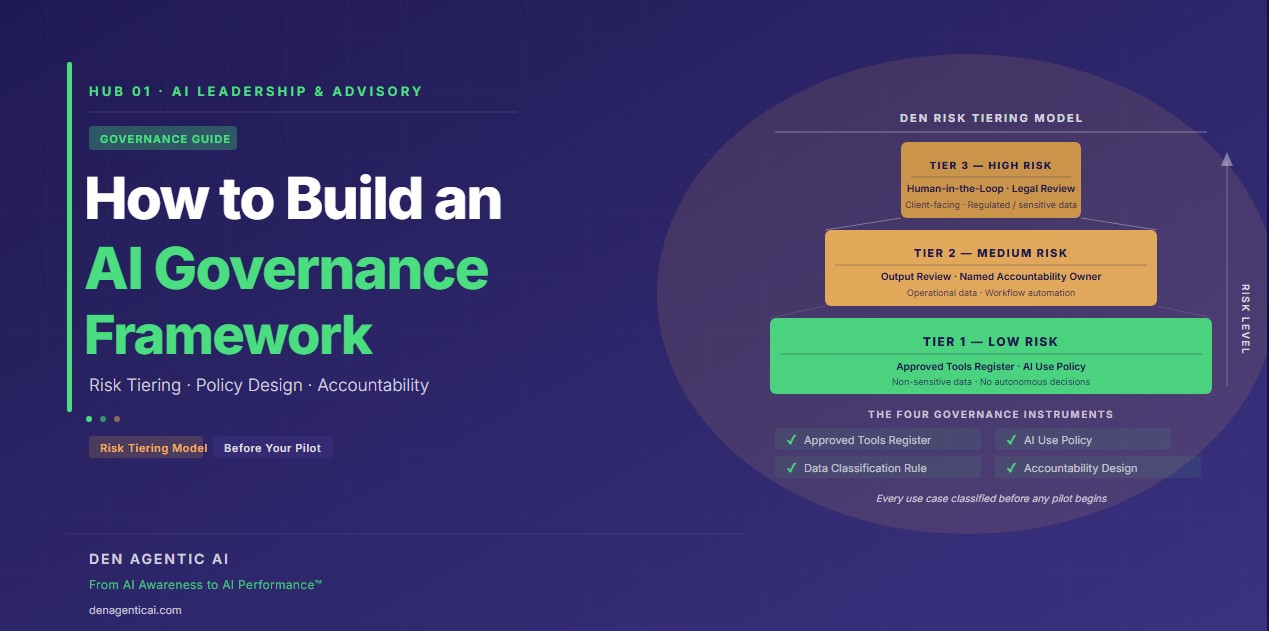
The DEN Risk Tiering Model
The foundation of a practical AI governance framework is a risk tiering model — a structured way to classify every AI use case by the level of oversight it requires. DEN uses a three-tier model.
Tier 1 — Low Risk
AI operating on non-sensitive internal data, with no autonomous decisions affecting people, processes, or external stakeholders.
Examples: Internal document summarization, meeting transcription and notes, writing assistance for internal communications, research compilation from public sources.
Governance requirements:
- Tool appears on the Approved Tools Register
- Users acknowledge the AI Use Policy
- No special review required for routine Tier 1 outputs
Tier 2 — Medium Risk
AI processing operational or business data, or automating internal workflows where outputs are used without manual review of every instance.
Examples: CRM data updates and categorization, internal report generation, workflow routing, email draft generation for internal use.
Governance requirements:
- All Tier 1 requirements
- Documented output review process (who reviews, at what frequency)
- Named accountability owner for the use case
- Data classification confirmation (data type confirmed as Tier 2 compatible)
Tier 3 — High Risk
AI taking actions with external impact, processing sensitive or regulated data, or making decisions that affect employees, clients, or organizational liability.
Examples: Client-facing AI agents or chatbots, automated contract processing, HR decision support, financial data analysis, any AI system where errors have regulatory or legal consequences.
Governance requirements:
- All Tier 1 and 2 requirements
- Legal review before deployment
- Human-in-the-Loop checkpoint at every decision node — not sampled, every instance
- Tested incident response playbook specific to this use case
- Override rate monitoring (what percentage of AI outputs are being overridden by human reviewers — rising override rates are an early warning signal)
The critical application of the model: Every AI use case your organization is currently running or planning, should be assigned a tier. This single exercise often produces the most important governance insight available to mid-market leadership: the discovery that Tier 3 tools are being used by employees who believe they are using Tier 1 tools.
The Four Governance Instruments
The AI Governance Framework document delivers four instruments. All four must be in place before any pilot begins.
1. Approved Tools Register
A documented list of every AI tool approved for organizational use, organized by:
- Tool name and category (writing assistant, workflow automation, data analysis, etc.)
- Approved use cases — what specific tasks is this tool permitted to support
- Data restrictions — what categories of data may be processed by this tool (maps to Data Classification Rule)
- Permission level — which roles or teams are approved to use this tool
Any AI tool not on the Approved Tools Register is classified as shadow AI — regardless of how widely it is being used inside the organization. The register is not a ban list. It is a clarity instrument. Once a tool is approved, it is approved consistently and transparently.
The register should be reviewed and updated quarterly. New tools added by employees without formal approval should trigger a classification process rather than automatic prohibition — the goal is visibility, not compliance theater.
2. AI Use Policy
A written policy of one to two pages, specific enough to be actionable and short enough to be read. The AI Use Policy covers:
- Acceptable use cases by tier — what AI can and cannot be used for in your organization
- Data handling rules — which data categories can be used with which tool classes (links to Data Classification Rule)
- Output review requirements — the standard for human review before an AI output is used or shared
- Prohibited uses — specific prohibitions (e.g., no AI processing of personally identifiable information in tools without a signed data processing agreement)
- Incident reporting — what constitutes a reportable AI incident and how to report it
The policy should be signed by every user before they access any AI tool on the Approved Tools Register. It is not an HR document — it is an operational document with a signature requirement.
3. Data Classification Rule
A single, clear rule that maps data categories to AI tool tiers. The most practical format:
| Data Category | Examples | Maximum AI Tier Permitted |
|---|---|---|
| Public / Non-sensitive | Published content, publicly available information | Tier 1 |
| Internal / Business operational | Internal reports, meeting notes, project data | Tier 2 |
| Confidential / Proprietary | Financial data, strategic plans, unreleased product info | Tier 2 (with approval) |
| Sensitive / Regulated | Client PII, employee records, health data, legal matters | Tier 3 only — with legal review |
This single rule prevents the most common governance incident: a Tier 1 tool (writing assistant, transcription app) being used with Tier 3 data (a sensitive HR conversation, a confidential client brief) because nobody documented the boundary.
4. Accountability Design
Governance without named accountability is policy without enforcement. The Accountability Design section of the framework names:
- AI Governance Owner — the single accountable person for AI governance oversight. Not a committee. One named individual with defined authority.
- Escalation paths by tier — who handles a Tier 1 concern, a Tier 2 output dispute, a Tier 3 incident
- Approval authority — who can add tools to the Approved Tools Register, and what process they must follow
- Review cadence — how often the framework documents are reviewed and updated (recommended: quarterly for the register, annually for the policy)
What the AI Governance Framework Is Not: The Operations Manual Distinction
Two governance documents are produced across the full AI strategy framework. They are different instruments and should never be presented as duplicative.
| AI Governance Framework (Step 5) | AI Operations Governance Manual (post-deployment) | |
|---|---|---|
| Nature | Constitutional — defines the rules | Operational — governs live running systems |
| Timing | Designed before any system is live | Built after systems are deployed and tested |
| Contents | Risk tiers, use policy, approved tools register, accountability design | Live workflow registry, credential rotation schedules, incident response playbooks, override rate monitoring |
| Audience | Board, leadership, governance owner | Operations managers, IT leads, workflow owners |
| Analogy | The constitution | The law enforcement manual |
Client-facing framing: “In Step 5, we design the rules of the road. After your first system is in production, we build the operations manual for when something on the road does not follow those rules.”
Common Governance Mistakes in Mid-Market Organizations
Mistake 1: Governance as a compliance checkbox. Producing a governance document to satisfy a board request, without operationalizing it. An AI Use Policy that exists but is not acknowledged, enforced, or reviewed is not governance — it is documentation.
Mistake 2: Assuming existing IT policy covers AI. General IT security policy does not address the specific risks of AI tools — data routing through third-party AI providers, output review requirements, the difference between a tool that stores data and one that trains on it. AI governance requires AI-specific instruments.
Mistake 3: Shadow AI ignored rather than classified. The right response to discovering that employees are already using unapproved AI tools is classification, not prohibition. Classify the tools against the risk tier model, determine what policy gap allowed them to emerge, and regularize the approved ones through the register.
Mistake 4: No named governance owner. Governance owned by a committee is governance owned by nobody. One named individual with defined authority is the minimum viable accountability structure.
Mistake 5: Building for current tools only. The AI tool landscape changes faster than annual policy reviews can track. The Approved Tools Register review process must be documented and functional, not just the register itself.
How This Connects to Your AI Strategy
The AI Governance Framework is Step 5 in the seven-step DEN AI Strategy Framework — designed after your initiative is specified (Step 4) and before your KPIs and cost model are finalized (Step 6).
This sequence is deliberate. The Canvas specification (Step 4) tells you which governance tier your initiative requires. The governance framework (Step 5) defines what that tier means in practice. The KPI design (Step 6) builds the measurement system that confirms governance is functioning once the pilot is live.
Organizations that complete Steps 4, 5, and 6 before launching a pilot have a board-ready package — an initiative that leadership can fund and approve without requiring the consultant to be in the room to explain why it is safe.
→ Full guide: The Complete Guide to AI Strategy for Mid-Market Leaders →
→ Take the free AI Governance Assessment (4 minutes) →
→ Check your shadow AI exposure: Shadow AI Pulse Check →
→ Book a free 30-minute AI governance consultation →
Frequently Asked Questions
Q: What is an AI governance framework? An AI governance framework is a constitutional document that defines the rules for all AI use in an organization — which tools are approved, what data can be used with which tool, who is accountable for AI outputs, and what constitutes a reportable incident. It is designed before any AI pilot begins and governs all AI initiatives that follow.
Q: Does a small or mid-market organization really need formal AI governance? Yes — and more urgently than enterprises in some respects. Enterprise organizations have legal and compliance teams that flag governance gaps before they become incidents. Mid-market organizations do not, which means the gap between ungoverned AI use and a damaging incident can close very quickly. The AI Governance Framework described here is designed to be proportionate to organizational size — one to two pages of policy, a single-page register, and one named accountability owner is a viable starting point.
Q: What is the difference between an AI governance framework and an AI use policy? The AI Use Policy is one of the four instruments inside the AI Governance Framework. The framework is the broader constitutional document — encompassing risk tiering, approved tools, data classification rules, and accountability design. The use policy is the specific, employee-facing document that defines what is and is not permitted in practice.
Q: How often should an AI governance framework be updated? The Approved Tools Register should be reviewed quarterly — the AI tool landscape changes too quickly for annual review to remain accurate. The AI Use Policy and Data Classification Rule should be reviewed annually, or whenever a significant new AI initiative or tool category is introduced. The accountability structure should be reviewed when organizational roles change.
Q: What triggers a Tier 3 classification? Any AI use case that (1) involves data that is regulated, personally identifiable, or legally sensitive, (2) produces outputs that directly affect client relationships, employment decisions, or financial transactions, or (3) operates autonomously with external stakeholders, should be classified Tier 3. When in doubt, classify higher and reduce the tier classification after a formal legal review confirms lower risk is appropriate.
Related Posts
- The Complete Guide to AI Strategy for Mid-Market Leaders →
- The Complete Guide to AI Governance →
- Shadow AI at Work — What It Is and How to Address It →
- How to Design AI KPIs and Measure Baseline Performance →
- How to Build a 90-Day AI Roadmap →
Written by Tariq Alam, Founder & Lead AI Advisor, DEN Agentic AI. Tariq specializes in AI governance framework design for mid-market organizations. Book a free consultation at denagenticai.com/ai-readiness-consultation