AI governance is the set of policies, accountabilities, and processes that define how artificial intelligence tools are selected, authorized, used, monitored, and corrected within an organization. It answers the questions that every AI initiative raises — but that no individual employee should be expected to answer alone:
- Which AI tools are we allowed to use, and with what data?
- Who is responsible when an AI system produces a harmful or incorrect output?
- How do we review AI outputs before they affect clients, employees, or regulatory obligations?
- What happens when an AI system fails?
For mid-market organizations — those with 50 to 500 employees — AI governance is not a compliance exercise. It is the operational prerequisite that determines whether any AI initiative delivers value or creates liability.
This guide covers everything a mid-market leader needs to build, implement, and sustain an AI governance framework that is practical, proportionate, and defensible.
Why AI Governance Is an Enabler, Not a Constraint
The most common misconception about AI governance is that it slows AI adoption. The opposite is true.
Deloitte’s 2026 AI Institute research found that organizations with a written AI use policy in place before their first AI pilot achieve significantly higher adoption rates than those that defer governance. The reason is counterintuitive but consistent:
Without governance, employees face two impossible choices every time they use an AI tool:
- “Am I allowed to use this tool with this type of data?”
- “Does someone need to review this output before I use it?”
When these questions go unanswered at the organizational level, cautious employees avoid AI tools entirely (removing the productivity benefit). Confident employees answer these questions liberally — creating governance exposure the organization doesn’t know it has. Both outcomes are failures.
A functional AI governance framework removes both failure modes simultaneously. It tells every employee:
- Which tools are approved
- What data boundaries apply
- Who reviews which outputs
- Who to contact when something goes wrong
That clarity — not the absence of rules — is what enables confident, widespread AI adoption.
The second misconception is that AI governance requires a legal team and months of policy drafting. A minimum viable AI governance framework for a 50–200 person organization can be built in two weeks with no external budget.
There is a third reason governance cannot wait: regulatory exposure is already present — not on the horizon. In the US, existing law (EEOC’s anti-discrimination guidance on AI in hiring, CFPB guidance on AI in credit decisions) applies now, and state-level AI laws are activating. Colorado’s automated decision-making law takes effect January 2027; it requires impact assessments, consumer disclosures, and governance documentation for AI used in consequential decisions. In Canada, PIPEDA governs personal data processed through AI systems, Quebec’s Law 25 adds obligations for automated decisions significantly affecting individuals, and sector regulators (OSFI for financial services, Health Canada) have issued AI-relevant guidance. The NIST AI Risk Management Framework — the de facto responsible AI standard in the US — provides the governance vocabulary that regulators, auditors, and enterprise clients increasingly expect organizations to demonstrate. Organizations building governance now are building compliance posture — not just operational structure.
→ Learn more: Shadow AI — the most common consequence of absent governance →
The DEN Risk Tiering Model: Proportionate Governance by Initiative
Not all AI initiatives carry the same governance requirements. Treating a meeting summarizer with the same rigor as an autonomous customer-facing chatbot is as counterproductive as having no governance at all.
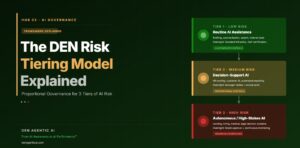
The DEN Risk Tiering Model is a three-tier framework that classifies every AI initiative by its potential for harm — and prescribes proportionate governance controls for each tier.
Tier 1 — Low Risk
Definition: AI tools used internally for assistive tasks. A human reviews every output before it is used. Even if the AI produces a wrong answer, the error is easily caught and corrected with minimal consequence.
Examples: Meeting notes summaries, internal draft emails, internal research summaries, document formatting assistance, knowledge search tools
Governance requirements:
- Employee is personally responsible for reviewing and validating the output before use (self-review)
- Tool must be on the Approved Tools Register
- No restricted data categories may be entered into the tool
- No client-facing or legally sensitive context
Oversight: Included in the standard AI usage policy. No additional review layer required.
Tier 2 — Medium Risk
Definition: AI tools used in client-facing workflows or in operational automations where errors could have moderate consequences — affecting client relationships, operational decisions, or organizational reputation.
Examples: AI-assisted proposal drafts, client report sections, marketing copy, automated data processing, email response drafting for client communications
Governance requirements:
- Supervisor or peer review required before any AI output is sent to a client, published, or acted upon in an operational workflow
- Tool must be on the Approved Tools Register with documented approved use cases
- Data restrictions explicitly documented (which client or employee data categories are prohibited)
- Quarterly review of tool performance and output quality by the AI Governance Owner
- Incident path clearly defined: who does an employee escalate to if the tool produces a harmful output?
Oversight: Tier 2 review is standard for all client-facing AI output. Supervisor sign-off is the minimum control.
Tier 3 — High Risk
Definition: AI systems that operate with significant autonomy, handle personal data, influence legal or financial decisions, or interact directly with clients without per-instance human review of every output.
Examples: Autonomous customer support chatbots, AI-mediated intake processing, financial analysis systems, HR decision support tools, legal document generation, compliance monitoring AI
Governance requirements:
- Subject matter expert (legal, HR, finance, compliance) must review AI outputs before they are acted upon — not just a supervisor
- A written risk assessment documenting specific failure modes, data handling procedures, and escalation protocols must be completed before deployment
- The AI Governance Owner must formally approve the initiative before it goes live
- Continuous monitoring with defined performance thresholds and automatic escalation if thresholds are breached
- Quarterly legal and compliance review
- Full audit trail of system decisions maintained for a defined retention period
Oversight: Tier 3 initiatives require the most preparation and the most sustained oversight. Most mid-market organizations at Level 1–2 maturity should not be deploying Tier 3 initiatives.
→ Full guide: The DEN Risk Tiering Model explained →
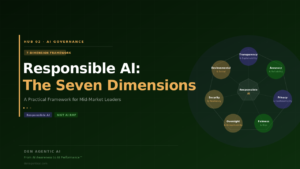
The 7 Dimensions of Responsible AI
AI governance is not only about who reviews which outputs. Responsible AI adoption — aligned with the NIST AI Risk Management Framework’s trustworthiness criteria — requires organizational commitment across seven dimensions, each addressing a distinct category of risk and harm.
1. Transparency
What it requires: Employees and clients should know when they are interacting with AI-generated content or AI-mediated processes.
Minimum standard: Any AI-generated content shared with clients must be disclosed as AI-assisted. Any AI-mediated client interaction (chatbot, automated response) must be identifiable as AI.
2. Accuracy & Reliability
What it requires: AI outputs that reach clients, influence decisions, or affect operational processes must be verified for factual accuracy before use.
Minimum standard: AI outputs in Tier 2 and Tier 3 contexts are treated as drafts requiring human verification — never as final answers. The output review tier (1, 2, or 3) determines who verifies and how.
3. Data Privacy & Confidentiality
What it requires: The organization’s confidential data — client information, employee data, financial data, proprietary business information — must be protected from unauthorized exposure through AI systems.
Minimum standard: A written data classification rule defines which data categories cannot be entered into any AI tool without explicit approval from the AI Governance Owner. This is the single highest-impact governance control available to a mid-market organization.
4. Bias & Fairness
What it requires: AI systems used in decisions affecting people — hiring, performance evaluation, client terms, credit or pricing decisions — must be assessed for systematic bias before deployment.
Minimum standard: Any AI system influencing decisions about individuals requires a documented bias review before deployment, and periodic review of output patterns post-deployment.
5. Human Oversight & Accountability
What it requires: A named human being must be accountable for every AI initiative — for its performance, its governance compliance, and its incident response. AI systems are not accountable. People are.
Minimum standard: Every AI initiative has a named AI initiative owner (typically the business sponsor). The AI Governance Owner is accountable for the governance framework overall.
6. Security & Resiliency
What it requires: AI systems — especially those with access to sensitive data or autonomous action capabilities — must be assessed for adversarial manipulation risks. Prompt injection, data poisoning, and excessive permission grants are governance failures, not just IT problems.
Minimum standard: Tier 2 and Tier 3 tools are reviewed for security risks as part of the Approved Tools Register process. Agentic AI systems operate under least-privilege access policies with defined action boundaries.
7. Environmental & Social Considerations
What it requires: Organizations should be aware of the resource consumption of large AI model usage and should not deploy AI in ways that create social harm — including displacing employees without transition support.
Minimum standard: Workforce change management and employee communication should accompany any AI deployment that significantly changes job roles or responsibilities.
→ Full guide: Responsible AI — the 7 dimensions every leader must govern →
The 5 Elements of a Minimum Viable AI Governance Framework
Element 1: A Named AI Governance Owner
Every AI governance framework begins with one person — not a committee — who is accountable for AI decisions and incidents within the organization. This person needs decision authority, not technical expertise.
Who typically holds this role: COO, Chief of Staff, VP Operations, IT Director, or a senior manager with cross-functional authority.
Responsibilities: Maintaining the Approved Tools Register. Answering questions about permitted tools and data uses. Receiving and responding to AI incident reports. Reviewing and updating the framework quarterly.
Element 2: An Approved Tools Register — and an AI Systems Inventory
The Approved Tools Register is a live list of every AI tool authorized for business use, specifying:
- Approved use cases for each tool
- Data restrictions (what data cannot be entered)
- Output review tier (Tier 1, 2, or 3) for outputs from that tool
A broader document — the AI Systems Inventory — extends this to capture all AI operating in or through the organization: AI embedded in vendor platforms (CRMs, HR tools, ERP systems), AI features enabled in SaaS updates without explicit approval, and employee-initiated tools that predate any governance process. The principle is simple: you cannot govern what you cannot see. Most organizations discover during their initial audit that they have more AI in production than anyone in leadership realized.
Format: A spreadsheet is sufficient for both. Build the Approved Tools Register first (the immediate governance priority), then extend it into the AI Systems Inventory during the 90-day audit cycle.
Update cadence: Quarterly minimum. The AI tool landscape changes faster than most policies.
Element 3: A Data Classification Rule
A single, clear written statement defining which categories of data cannot enter any AI tool without explicit written approval from the AI Governance Owner.
Minimum viable data classification rule: “The following data categories may not be entered into any AI tool without explicit written approval from the AI Governance Owner: (1) client-identifying or client-confidential data, (2) employee personal data, (3) financial data, (4) data subject to regulatory restrictions.”
This closes the single most common shadow AI exposure path: an employee deciding individually whether pasting client information into ChatGPT is acceptable.
Element 4: A Three-Tier Output Review Policy
Defines who reviews what AI output before it is used, shared, or sent. The three tiers:
Tier 1 — Internal, Low Consequence: Employee self-review. The person who prompted the AI validates the output before using it. (Examples: meeting notes, internal draft emails)
Tier 2 — Client-Facing, Moderate Consequence: Supervisor review before sending or publishing. AI output is a draft input to a human-reviewed final. (Examples: client reports, proposals, marketing copy)
Tier 3 — Legal, HR, Financial, or Regulatory Context: Subject matter expert sign-off required. AI output is a draft for expert review only — never a final answer. (Examples: contract language, HR policy interpretation, financial calculations)
Element 5: An AI Incident Response Path
A simple, communicated process for what to do when AI produces a harmful, inaccurate, or inappropriate output that reaches a client, affects an employee, or creates a regulatory exposure.
Minimum viable incident response path:
- Stop using the output immediately
- Report to the AI Governance Owner within 24 hours
- AI Governance Owner investigates and determines whether to suspend the tool pending review
- Document the incident and the corrective action
- Review whether the data classification rule, output review policy, or Approved Tools Register needs updating
→ Full guide: How to build an AI governance framework →
Step-by-Step: Building Your First AI Governance Framework in 14 Days
| Day | Action |
|---|---|
| 1 | Name the AI Governance Owner. Communicate the appointment to all staff. |
| 2–5 | Audit current AI tool use: survey all teams. “Which AI tools do you use in your daily work?” |
| 5–10 | Create the first Approved Tools Register. Classify discovered tools as Approved / Under Review / Suspended. |
| 10 | Write the data classification rule. One paragraph. Reviewed by legal if available. Communicated to all staff. |
| 12 | Publish the three-tier output review policy. One page. Include examples of what falls in each tier. |
| 14 | Schedule the first quarterly review. Add “AI Governance Review” to the AI Governance Owner’s calendar. |
This is your minimum viable AI governance framework. It takes two weeks and zero external budget. What it creates is the governance foundation that every subsequent AI initiative is built on.
→ Take the free Governance Assessment to see where you stand today →
The AI Governance Operating Manual: What It Contains
Organizations at Level 3 maturity and above should formalize their governance into a written AI Governance Operating Manual — a living document that goes beyond the minimum viable framework to address the full governance lifecycle.
A complete AI Governance Operating Manual includes:
- Governance Principles: The organization’s stated position on transparency, accuracy, data privacy, fairness, accountability, and responsible AI
- The DEN Risk Tiering Model Application: How each AI initiative is classified by risk tier, with documented criteria
- The Approved Tools Register: Current approved tools, use cases, data restrictions, and review tiers
- The Data Classification Rule: All restricted data categories with examples
- The Three-Tier Output Review Policy: Full policy with role-specific guidance and examples
- The AI Incident Response Procedure: Step-by-step incident reporting, investigation, and escalation paths
- The AI Governance Owner Role Description: Accountabilities, decision authorities, and escalation paths
- The Governance Metrics Dashboard: What the organization tracks to confirm governance is working
- The Quarterly Review Process: What is reviewed, by whom, on what cadence
- The Employee Communication Template: Standard communications for policy updates, new tool approvals, and incident responses
The AI Governance Operating Manual is the primary deliverable of Service 3 in the DEN Agentic AI advisory engagement.
Measuring AI Governance Effectiveness
An AI governance framework that is not measured is not governed — it is assumed to be working. The AI Governance Metrics Dashboard tracks four categories of governance health:
Policy Compliance Metrics:
- % of AI tool usage within the Approved Tools Register (measured via periodic audit or usage reporting)
- % of staff who have read and acknowledged the AI use policy (tracked on sign-off)
- Number of shadow AI incidents detected in periodic audit (target: declining over time)
Output Quality Metrics:
- AI output revision rate by tier (what % of AI outputs require significant human correction before use?)
- Client-visible AI error rate (how often do AI errors reach clients despite Tier 2 review?)
Governance Incident Metrics:
- Number of AI incidents reported per quarter (this metric should increase initially as reporting culture develops, then stabilize)
- Average time from incident detection to AI Governance Owner response
- % of incidents resulting in Approved Tools Register or policy update
Maturity Advancement Metrics:
- Governance dimension maturity score (tracked quarterly via self-assessment using the AI Capability Maturity Model)
- Number of AI initiatives operating under each risk tier (a governance-healthy portfolio has more Tier 1 initiatives than Tier 3)
→ Full guide: AI Governance Metrics — what to track and why →
Common AI Governance Failures — and How to Avoid Them
Failure 1: Governance as a Phase 2 Activity. Building governance after the pilot is running. By the time governance is established, ungoverned habits are already embedded and data exposure has already occurred.
Fix: Governance framework must be complete before the first AI pilot begins. It is Phase 1 of the 90-day roadmap, not Phase 2.
Failure 2: A Policy Without an Owner. A written AI use policy that has no named enforcement authority. When employees have questions or incidents occur, there is no one to escalate to.
Fix: The first governance action is naming the AI Governance Owner and communicating it to all staff. Policy without ownership is decoration.
Failure 3: A Static Approved Tools Register. An Approved Tools Register that is reviewed annually (or never) while the AI tool landscape changes quarterly.
Fix: The Approved Tools Register must be reviewed at least quarterly. Tools not on the register are not approved — this rule must be enforced.
Failure 4: Risk Tier Misclassification. Classifying AI Assist tools as Tier 3 (over-governing low-risk tools and creating friction) or classifying AI automations as Tier 1 (under-governing high-risk tools and creating exposure).
Fix: Apply the DEN Risk Tiering Model criteria consistently. When in doubt, classify under the higher tier.
Failure 5: No Incident Reporting Culture. Employees who witness AI errors (including their own) do not report them because there is no clear reporting path and no culture of psychological safety around AI mistakes.
Fix: Communicate the incident reporting path clearly and repeatedly. Treat the first AI incident not as a failure but as the governance framework working as designed.
Failure 6: Underestimating Agentic AI. AI agents — systems that autonomously take multi-step actions (browsing the web, sending emails, calling APIs, triggering workflows) — are being adopted faster than governance frameworks are being updated to address them. A Tier 1 tool governance framework is entirely inadequate for an AI agent that can send client communications autonomously.
Fix: Any AI system with autonomous action capabilities — regardless of the original tool category — must be reclassified as Tier 3. Agentic features added to existing tools are a re-classification trigger, not a feature upgrade. The governance controls for autonomous systems are fundamentally different from those for assistive tools.
How DEN Agentic AI Supports AI Governance
Service 3 — AI Governance & Responsible Adoption is the DEN Agentic AI advisory engagement designed specifically for mid-market organizations building or strengthening their AI governance.
Deliverables:
- AI Governance Operating Manual (complete, ready-to-enforce)
- Risk Tiering Register for all planned initiatives
- Adoption Metrics Dashboard
- Leadership Communication Playbook
- Responsible AI self-assessment and gap closure plan
Target buyers: COO, Operations Director, Digital Transformation Lead, Legal/Compliance Officer
The free Governance Assessment at denagenticai.com/governance-assessment maps your current governance state against the four minimum viable governance elements in 5 minutes and produces a gap analysis that tells you exactly where to start.
→ Take the Free Governance Assessment →
→ Book a free 30-minute consultation to discuss your governance needs →
Frequently Asked Questions
Q: What is AI governance and why do businesses need it? AI governance is the set of policies, accountabilities, and processes that define how AI tools are selected, authorized, used, monitored, and corrected within an organization. Businesses need it because ungoverned AI use — even well-intentioned use — creates data exposure, output quality risks, compliance liability, and employee uncertainty that undermines AI adoption. Governance is not a constraint on AI adoption; it is the prerequisite for confident, scalable AI adoption.
Q: What is the minimum viable AI governance framework for a mid-market organization? The minimum viable AI governance framework has five elements: (1) A named AI Governance Owner, (2) An Approved Tools Register, (3) A written Data Classification Rule, (4) A Three-Tier Output Review Policy, and (5) An AI Incident Response Path. This framework can be built in two weeks at no external cost.
Q: How does the DEN Risk Tiering Model work? The DEN Risk Tiering Model classifies AI initiatives into three tiers based on their potential for harm: Tier 1 (Low Risk — internal assistive tools with self-review), Tier 2 (Medium Risk — client-facing or operational tools with supervisor review), and Tier 3 (High Risk — autonomous systems with SME sign-off and formal risk assessment). Each tier has proportionate governance requirements — preventing both under-governance of high-risk tools and over-governance of low-risk ones.
Q: How does AI governance relate to data privacy regulations (GDPR, PIPEDA)? AI governance and data privacy policy serve overlapping but distinct purposes. Data privacy policy governs how personal data is collected, stored, and processed under regulatory frameworks. AI governance specifically governs how AI tools are authorized and how data is handled within AI contexts. Organizations operating under GDPR, PIPEDA, or HIPAA should treat their data classification rule as a governance-to-compliance bridge — the categories of restricted data in the classification rule should align with the personally identifiable and sensitive data categories defined in the privacy policy.
Q: What is shadow AI and how does governance address it? Shadow AI is the use of AI tools by employees without organizational knowledge, authorization, or governance oversight. It is the inevitable result of absent governance — employees discover productivity benefits and start using tools independently without knowing the rules. The Approved Tools Register and the Data Classification Rule are the two governance controls that directly address shadow AI: the register tells employees which tools are approved, and the classification rule tells them which data boundaries apply to all AI tool use.
→ Read: Shadow AI at Work — what it is and how to address it →
Related Posts — Hub 2: AI Governance & Responsible Adoption
- Shadow AI at Work: What It Is and How to Address It →
- How to Build an AI Governance Framework for Your Business →
- How to Write an AI Use Policy Your Team Will Actually Follow →
- The DEN Risk Tiering Model: Proportionate AI Governance Explained →
- Responsible AI: The 6 Dimensions Every Leader Must Govern →
- AI Governance Metrics: What to Track and Why →