

Mid-market organizations beginning their AI journey often encounter two seemingly similar governance concepts in rapid succession: data governance and AI governance. Both involve policies, ownership, and controls. Both have to do with how the organization manages its information assets. And both are prerequisites for trustworthy AI adoption.
But they are not the same thing — and treating them as interchangeable creates gaps that neither framework fully covers.
This guide explains what each discipline does, where they overlap, how they differ, and what a practical approach looks like for a 50–500 person organization that needs both without building two separate programmes. Data governance is the discipline that underpins the Assure step of DEN Agentic AI’s Agentic Data & Analytics Solutions method, while AI governance is applied through the Decide and Improve steps of AI Workforce & Automation Solutions — the two engagements are designed to reference the same underlying controls rather than duplicate them.
What Is Data Governance?
Data governance is the organizational framework that defines how data is owned, maintained, classified, and accessed across all uses — not just AI uses. It answers the questions:
- Who owns each data asset, and is accountable for its accuracy?
- How is sensitive or confidential data identified and protected?
- What are the authoritative definitions of key business metrics?
- How long should data be retained, and what happens when it is no longer needed?
- Who has access to which data, and how is that access granted and revoked?
Data governance predates AI. It emerged from the need to manage relational databases, regulatory compliance (GDPR, HIPAA, PIPEDA), and business intelligence in an era before generative AI existed. A mature data governance programme ensures that the organization’s data is trustworthy and well-managed regardless of what tools consume it.
Core data governance controls:
- Data ownership assignments (named owners per domain)
- Data classification schema (public, internal, confidential, restricted)
- Business glossary / data dictionary (metric definitions and source-of-truth mapping)
- Data retention and archival policies
- Access control framework (who can read, write, or export each data category)
- Data quality standards and measurement processes
What Is AI Governance?
AI governance is the framework that defines how AI tools are selected, authorized, used, monitored, and corrected within the organization. It answers a different set of questions:
- Which AI tools are approved for business use, and with what data?
- Who is accountable when an AI system produces a harmful or incorrect output?
- How are AI outputs reviewed before they affect clients, employees, or operational decisions?
- How are AI initiatives classified by risk, and what controls apply at each risk level?
- What happens when an AI system fails or produces an incident?
AI governance is specifically about governing AI tool adoption and AI initiative risk — not about managing data assets generally. Its scope is narrower in one sense (only AI-related activities) but broader in another (it includes accountability for AI outputs, client transparency, bias review, and incident response that have no analogue in traditional data governance).
Core AI governance controls:
- Named AI Governance Owner
- Approved Tools Register
- Data classification rule (which data categories cannot enter AI tools)
- Three-tier output review policy
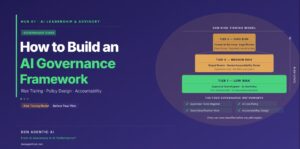
- Risk Tiering Model (Tier 1 / 2 / 3 classification)
- AI incident response path
- Responsible AI commitments (transparency, fairness, oversight, security)
Where They Overlap
The most direct point of overlap is the data classification rule in the AI governance framework. When the AI Governance Owner defines which data categories cannot enter AI tools without explicit approval, they are applying data governance principles to an AI-specific context.
If a mature data classification schema already exists in your data governance programme — with clear categories for Confidential, Restricted, and Regulated data — the AI governance data classification rule simply maps to that schema. “Data classified as Restricted under the data governance policy may not be entered into any AI tool without explicit written approval from the AI Governance Owner.”
This is the fastest path to a functional AI data classification rule for organizations that already have data governance infrastructure: don’t reinvent the classification — apply what already exists to the AI context.
Other overlap zones:
- Metric definitions: The semantic layer built for data governance (how “revenue” is defined, where “active client” is calculated) is exactly what AI systems need to produce consistent, reliable outputs from structured data queries.
- Data ownership: Data owners identified in the data governance programme are the natural accountability holders for AI data use within their domain.
- Access controls: Data access permissions established through data governance directly inform which AI tools should be permitted to query which data sources.
Where They Differ
| Dimension | Data Governance | AI Governance |
|---|---|---|
| Scope | All data, all uses | AI tools and AI initiatives specifically |
| Primary concern | Data quality, consistency, compliance | AI output reliability, risk, accountability |
| Key owner | Chief Data Officer, IT Director, Data Steward | AI Governance Owner (COO, VP Operations, IT Director) |
| Client-facing controls | Data sharing agreements, privacy policy | AI transparency disclosure, output review policy |
| Risk framework | Data sensitivity classification | AI initiative risk tiering (Tier 1/2/3) |
| Incident type | Data breach, data quality failure, compliance violation | AI hallucination reaching client, bias in AI decision, unauthorized AI data use |
| Review cadence | Data quality audits, access reviews | Approved Tools Register review, AI performance metrics |
A Practical Approach: Build Both — Without Building Twice
For a mid-market organization, the efficient approach is to build AI governance first (it is faster and more urgent, given shadow AI risk) and then extend it into data governance as the data architecture matures.
If you are starting from scratch (no data governance, no AI governance):
- Build the AI governance framework first — it takes two weeks and directly addresses shadow AI risk. The AI data classification rule is a simplified subset of full data governance.
- Assign data owners as part of the AI tool audit (the governance assessment naturally surfaces who uses which data).
- Build the semantic layer as your first significant data governance investment — it has the highest AI impact per dollar.
- Extend into a full data classification schema and access control framework as data architecture matures.
If you have existing data governance but no AI governance:
You have a significant head start. Your data classification schema, data owners, and metric definitions are directly reusable in the AI governance framework. Build the AI governance framework by mapping your existing data governance controls to the AI-specific requirements: apply the data classification schema to the AI data rule, appoint the AI Governance Owner (probably already your Data Steward or IT Director), and add the AI-specific controls (Approved Tools Register, output review policy, risk tiering) on top.
→ Full guide: How to build an AI governance framework →
→ Full guide: What is AI-ready data →
→ Take the free Governance Assessment →
→ Return to Hub 4: The Complete Guide to AI-Ready Data Architecture →
Frequently Asked Questions
Q: What is the difference between data governance and AI governance? Data governance covers how organizational data is owned, defined, classified, and accessed across all uses. AI governance covers how AI tools are selected, authorized, used, and overseen — including output review, risk tiering, incident response, and responsible AI commitments. They overlap significantly on data classification and ownership, but AI governance extends beyond data management into accountability for AI behavior, client transparency, and AI-specific risk.
Q: Do I need both data governance and AI governance? Yes — but you can build them in sequence rather than simultaneously. AI governance should come first: it is faster to implement, directly addresses shadow AI risk, and does not require a mature data infrastructure. Data governance comes next, building the foundation that makes AI tools more reliable over time. The two frameworks should be designed to reference each other rather than operate in parallel silos.
Q: Who should own data governance vs AI governance? In a mid-market organization, the roles often overlap significantly. The AI Governance Owner (typically COO, IT Director, or VP Operations) and the person responsible for data management (Data Steward, IT Director, or CTO) may be the same person or report to each other. What matters is that both accountabilities are explicitly named — not that separate programmes are created.
Q: Can I use my existing data classification for the AI governance data rule? Yes — and you should. If your organization already classifies data as Confidential, Restricted, or Regulated, the AI data classification rule can directly reference those categories: “Data classified as Restricted or Regulated under the organizational data classification schema may not be entered into any AI tool without explicit written approval from the AI Governance Owner.” This prevents duplication and ensures consistency between the two frameworks.