

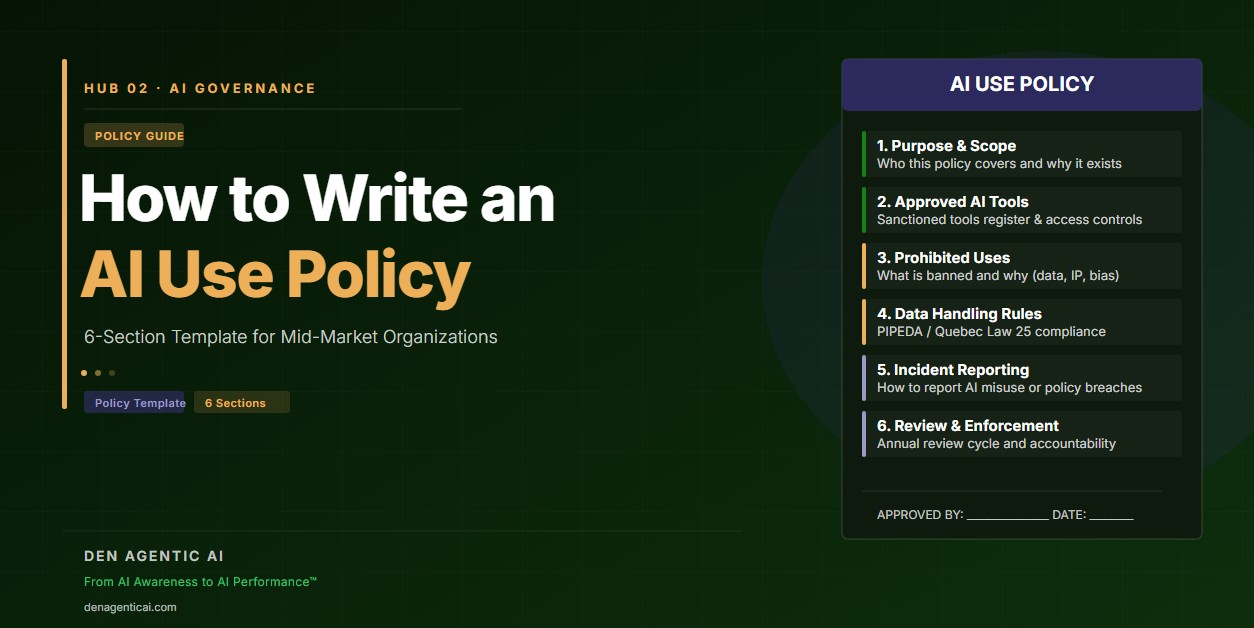
An AI use policy is a written document that defines which AI tools your employees are authorized to use, what data they may and may not enter into those tools, how AI outputs must be reviewed before use, and who is responsible when something goes wrong.
Most mid-market organizations either have no AI use policy — leaving employees to make individual judgment calls — or have a policy that is so long, jargon-heavy, or impractical that employees ignore it after the first read.
This guide explains what an effective AI use policy must include, how to write it in language your team will actually understand and follow, and how to communicate it in a way that changes behavior — not just creates a document.
Why Most AI Use Policies Fail
The failure modes for AI use policies are predictable:
Too long and too generic. A 12-page policy that covers every possible AI scenario in abstract regulatory language will not be read by the people it is meant to govern. The goal is behavioral change, not legal completeness.
No named owner. A policy with no named person to answer questions about it will be interpreted differently by different teams. Governance without accountability is decoration.
Static. An AI use policy written in 2024 that has never been updated is almost certainly missing AI tools and use cases that are now common in the organization.
Published, not communicated. A policy that was emailed once and never mentioned again does not govern anything. Governance requires active communication, not one-time publication.
An effective AI use policy is short enough to read in 5 minutes, specific enough to answer real employee questions, owned by a named person, and reviewed quarterly.
What an AI Use Policy Must Include: 7 Essential Sections
Section 1: Purpose (1 paragraph)
State clearly why the policy exists and what it is designed to achieve. The purpose is not “to restrict AI use” — it is to enable confident, authorized AI use by removing ambiguity.
Example purpose statement: “This policy defines how [Organization Name] employees may use artificial intelligence tools in their work. Its purpose is to enable productive AI use while protecting client data, maintaining output quality, and managing organizational risk.”
Section 2: Scope (1 paragraph)
Define who the policy applies to and what AI tools it covers. Be specific: does it apply to all employees, contractors, and third parties? Does it cover all AI tools or only specific categories?
Example scope statement: “This policy applies to all employees, contractors, and third parties working on behalf of [Organization Name]. It applies to all AI tools used in any work context, including tools accessed on personal devices during work hours.”
Section 3: Approved Tools (reference the Approved Tools Register)
Do not list every approved tool in the policy itself — this creates a version control problem. Instead, reference the Approved Tools Register and make it clear that only tools on the register are permitted.
Example: “Only AI tools listed in the current Approved Tools Register may be used for business purposes. The register is maintained and updated quarterly by the AI Governance Owner. Using any AI tool not on the register for business purposes is a policy violation.”
Include a direct link to the current Approved Tools Register.
Section 4: Data Classification Rule (1–2 paragraphs)
State clearly which data categories cannot be entered into any AI tool without explicit written approval from the AI Governance Owner. Use plain language. Provide concrete examples.
Example: “The following types of information must not be entered into any AI tool without explicit written approval from the AI Governance Owner: (1) client names, contact details, financial information, or any other client-identifying information; (2) employee personal data including names, salaries, performance reviews, or health information; (3) financial data including revenue figures, margins, or unpublished forecasts; (4) data subject to regulatory restrictions (GDPR, PIPEDA, HIPAA, etc.).”
Then: “If you are unsure whether the information you want to use is restricted, ask the AI Governance Owner before using it. When in doubt, leave it out.”
Section 5: Output Review Requirements (the three-tier table)
Present the three-tier output review policy in a clear table format. Employees need to be able to look at a table and immediately identify which tier applies to their situation.
| Tier | Context | Review Required |
|---|---|---|
| Tier 1 | Internal use only, easily reversible | Self-review by the employee who generated the output |
| Tier 2 | Client-facing, external communications, or operational decisions | Supervisor review and sign-off before use or sending |
| Tier 3 | Legal, HR, financial, or regulatory context | Subject matter expert sign-off required |
Include one concrete example for each tier so employees can calibrate immediately.
Section 6: Who to Contact (the AI Governance Owner)
Name the AI Governance Owner by name, role, and contact method. Define what employees should contact them for: tool authorization questions, data classification questions, and incident reporting.
Example: “All questions about AI tool authorization, data handling, and incident reporting should be directed to [Name], [Role], at [email]. Questions will be acknowledged within one business day.”
Section 7: Incident Reporting
Define what an AI incident is and what employees should do when one occurs. Keep it simple: stop using the output, report to the AI Governance Owner within 24 hours, and document what happened.
Example: “If an AI tool produces output that is factually wrong and has already reached a client, contains information that should not have been processed, or violates this policy, this is an AI incident. Report AI incidents to [AI Governance Owner name] within 24 hours. Incidents will be investigated and resolved within 5 business days.”
How to Write the Policy: 5 Practical Rules
Rule 1: Aim for one page. A one-page AI use policy that is read by 90% of employees is more effective than a five-page policy read by 10%. If you can’t fit it on one page, create a one-page summary and a full version — and communicate the summary.
Rule 2: Write it in plain language. “Employees may not enter restricted data into AI tools” is clearer than “Staff members are prohibited from the ingestion of categorically sensitive information into machine-learning applications.” Write for a first-year employee, not for a compliance audit.
Rule 3: Be specific about consequences. If policy violation has consequences, state them. “Using an unapproved AI tool for business purposes will be treated as a technology policy violation” is more effective than leaving the question ambiguous.
Rule 4: Acknowledge productive AI use explicitly. An AI use policy should say clearly that productive AI use is encouraged. If the policy reads as purely restrictive, employees will respond to it as a barrier — not as guidance.
Rule 5: State the review cadence. Every AI use policy should include a statement like: “This policy will be reviewed and updated by the AI Governance Owner every 90 days. The current version is always available at [link]. Employees will be notified of material updates.”
How to Communicate the Policy So It Changes Behavior
Writing the policy is 20% of the work. The other 80% is communication.
Communication Step 1 — All-staff email from the AI Governance Owner: Not from IT. Not from HR. From the named AI Governance Owner. This signals that AI governance is a leadership priority, not a compliance exercise.
Communication Step 2 — Team briefing (10 minutes). The AI Governance Owner or team manager walks the team through the three questions every employee needs to be able to answer after reading the policy: Which tools are approved? What data is off-limits? Who do I contact with questions?
Communication Step 3 — Quick reference card. A one-page (or one-slide) quick reference covering the Approved Tools Register link, the data classification rule in bullet form, the three-tier review table, and the AI Governance Owner contact. Pin it in your team’s shared channel.
Communication Step 4 — Written acknowledgment. Ask employees to confirm they have read and understood the policy. A simple email reply or a checkbox in your HR system. This is both a governance control and a signal that the organization is serious about it.
→ Download the free Responsible AI Use Policy Starter Template →
→ Take the free Governance Assessment to identify your policy gaps →
→ Return to Hub 2: The Complete Guide to AI Governance →
Frequently Asked Questions
Q: How do I write an AI use policy for my employees? Write an AI use policy with seven sections: purpose, scope, approved tools reference, data classification rule, output review requirements (three-tier table), AI Governance Owner contact, and incident reporting procedure. Aim for one page. Write in plain language. Review every 90 days.
Q: What should an AI acceptable use policy include? At minimum: which tools are authorized (reference the Approved Tools Register), which data categories are prohibited, who reviews AI outputs at each consequence level, and who to contact for questions and incidents. The AI Governance Owner name and contact must be explicit.
Q: How long should an AI use policy be? One to two pages for the policy itself, with a one-page quick reference card for daily use. Longer policies are less likely to be read and followed. If regulatory or compliance requirements demand additional detail, create a full policy with a plain-language summary.
Q: How often should an AI use policy be updated? Quarterly. The AI tool landscape changes fast enough that a policy reviewed annually will be out of date by the time it is next reviewed. Quarterly review also signals to employees that AI governance is an active organizational priority.
Q: Do I need a lawyer to write an AI use policy? For an initial minimum viable policy, no. Legal review is recommended when the policy includes data handling obligations that intersect with regulatory frameworks (GDPR, HIPEDA, PIPEDA, HIPAA), client contract terms, or employment obligations. For a starting framework for internal tool use, the AI Governance Owner can draft and communicate it without external counsel.