The most common reason AI business cases fail CFO review is not that the opportunity is small. It’s that the numbers are optimistic in ways a financially literate reviewer will immediately identify.
Calculating AI ROI accurately requires accounting for four cost categories that most AI proponents ignore: oversight costs, error and correction costs, adoption curve adjustments, and technical debt. It also requires building a measurement framework that produces verifiable numbers — not estimates.
This guide walks through a realistic AI ROI calculation model that will survive CFO scrutiny, board review, and the test of post-deployment actuals.
The Standard AI ROI Formula (And Its Flaws)
The most commonly used AI ROI formula is:
ROI = (Value Generated − Total Cost) / Total Cost × 100
The formula is not wrong. The problem is what most people put into it.
Value Generated is typically overstated because:
- Estimated time savings assume 100% AI adoption — real adoption is almost never 100%
- Time saved is not automatically converted to value created (a team member who saves 2 hours may reallocate that time to administrative work, not billable output)
- Error reduction benefits are included at gross value without accounting for the errors AI itself introduces
Total Cost is typically understated because:
- Oversight costs (the human time required to review AI outputs) are excluded entirely
- Training time and AI literacy development are excluded
- Error correction costs (fixing AI mistakes) are not included
- IT and integration maintenance time is not accounted for
A business case built with overstated benefits and understated costs will survive the pitch meeting. It will not survive the 6-month review.
The DEN Agentic AI ROI Framework: 3 Rules Before the Numbers
Rule 1: Apply the 40% Buffer
Every AI time-saving estimate must be reduced by at least 40% to account for:
- Adoption curve (the team will not reach full utilization immediately)
- Output review time (Tier 2 and Tier 3 outputs require human review — which costs time even when the AI drafts correctly)
- Prompt iteration (getting consistently useful AI outputs requires iteration that is not captured in “time saved” estimates)
Example: If an AI tool is projected to save 5 hours/week, use 3 hours/week in the business case.
Rule 2: Apply the Blocker Rule
If any single dependency — API access, data format, governance approval, staff training — is not confirmed before presenting the business case, apply a full stop. Do not present a business case with unresolved dependencies.
Rule 3: Use a 3-Gate Investment Model
Never commit the full AI investment budget upfront. Structure the investment in three gates:
- Gate 1 — Proof of Concept (PoC): 30 days, minimal budget, validates the technical assumption
- Gate 2 — Controlled Pilot: 60 days, one team, one workflow, full measurement
- Gate 3 — Production Deployment: Full rollout, triggered only if Gate 2 meets defined success metrics
This model limits downside exposure and gives the CFO a structured decision point rather than a binary approve-or-reject choice.
The AI ROI Calculation: Step by Step
Step 1: Establish a Baseline (Before AI)
For the specific task or workflow you are targeting, measure:
- Frequency: How many times per week is this task performed?
- Duration: How long does it take per instance?
- Error rate: How often does the current process produce an error requiring rework?
- Cost per instance: Time × hourly rate of the person performing the task
Example: Writing first-draft client status reports. 8 reports/week × 45 minutes each = 6 hours/week × $75/hr fully loaded cost = $450/week baseline cost
Step 2: Project the AI-Assisted Outcome
With AI assistance, estimate:
- Time per instance with AI (including AI generation + human review)
- Review time by tier (Tier 1 = self-review, Tier 2 = supervisor review)
- Error rate change (will AI reduce errors, introduce new ones, or both?)
Example: AI drafts the report in 3 minutes. Human reviews and edits: 12 minutes. Total: 15 minutes per report (vs. 45 minutes baseline).
Step 3: Apply the 40% Buffer
Example continued: Projected time saving = 30 minutes/report × 8 reports = 4 hours/week. Apply 40% buffer → 2.4 hours/week as the business case figure.
Projected annual value: 2.4 hours × $75/hr × 50 working weeks = $9,000/year
Step 4: Calculate True Total Cost
Include all four cost categories:
- Software cost: Tool subscription or API usage cost
- Setup cost: IT integration, configuration, and testing time (one-time)
- Training cost: AI literacy and prompting training (one-time)
- Oversight cost: Ongoing AI Governance Owner and review time
- Maintenance cost: Annual updates and review cadence
Example: Software $1,200/year + setup $2,000 one-time + training $800 one-time + oversight $50/week × 50 weeks = $7,300 Year 1 total cost
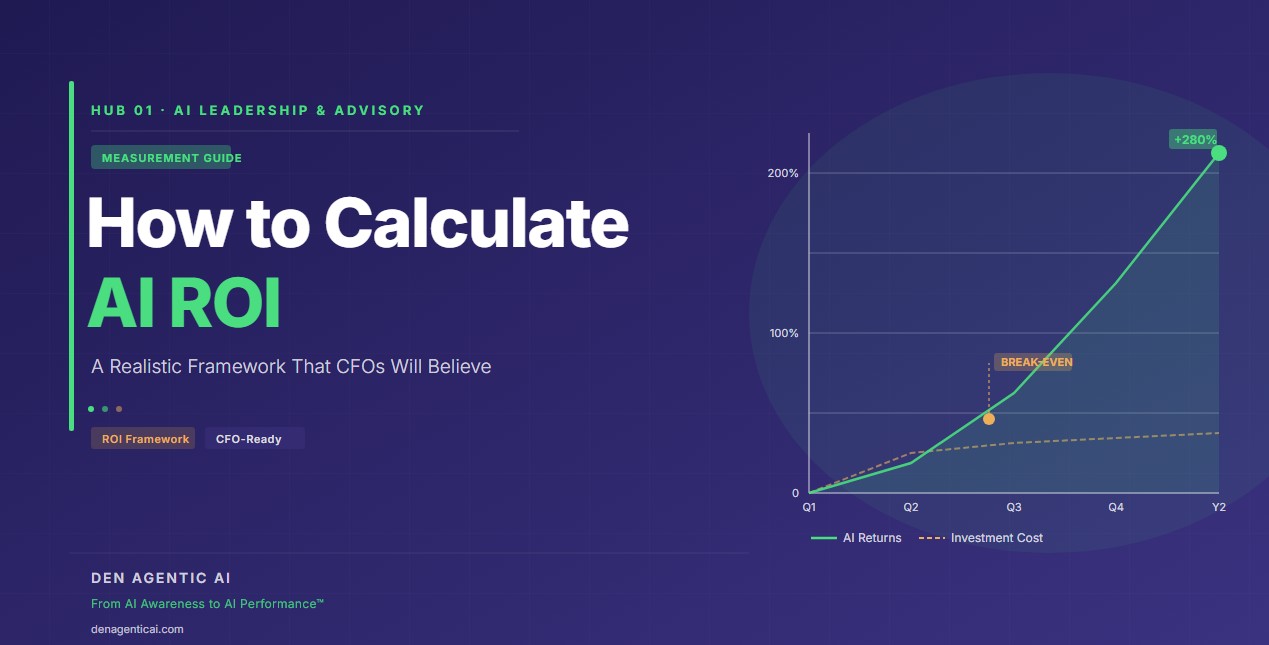
Step 5: Calculate Year 1 ROI
ROI = ($9,000 benefit − $7,300 cost) / $7,300 cost × 100 = 23% in Year 1
Year 2 (no setup cost): $9,000 benefit − $4,500 cost = $4,500 net benefit → 100% ROI
This is a realistic, defensible calculation that survives post-deployment review.
Step 6: Define the 3 KPIs You Will Track
Every AI business case must commit to three measurable KPIs before deployment:
- Outcome KPI: The business result the AI is intended to improve (e.g., time per report)
- Process KPI: A metric that confirms the AI is being used as intended (e.g., adoption rate)
- Quality KPI: A metric that ensures AI output quality is maintained (e.g., revision rate on AI drafts)
These three KPIs are measured at baseline, at Gate 1 (PoC review), and at Gate 2 (pilot review). If Stage 2 actuals fall below projections by more than 20%, the Stage 3 production decision requires re-evaluation.
Presenting AI ROI to Your CFO
Structure the CFO presentation in this order:
- The business problem (in numbers — not narrative)
- The solution approach (which quadrant, which governance tier)
- The 3-gate investment model (with Stage 1 PoC cost only as the initial ask)
- The baseline KPIs (measured, not estimated)
- The conservative business case with 40% buffer applied
- The Gate 2 decision criteria (what numbers trigger Stage 3 production approval)
This structure gives a financially rigorous CFO everything needed to approve Gate 1 — and a clear framework for evaluating whether to continue.
→ Select which AI use cases to build a business case for first →
→ Sequence your approved initiatives into a roadmap →
→ Return to Hub 1: The Complete Guide to AI Strategy →
Frequently Asked Questions
Q: How do you calculate ROI on an AI project? Calculate AI ROI by comparing the value generated (time savings × hourly cost, error reduction, revenue impact) against the full cost (software, setup, training, oversight, maintenance). Apply a 40% buffer to all benefit estimates. Use: ROI = (Value Generated − Total Cost) / Total Cost × 100.
Q: What is the 40% buffer rule in AI ROI calculation? The 40% buffer reduces projected AI time savings before they enter a business case, accounting for adoption curves, output review time, and prompt iteration. An initiative projected to save 10 hours/week should use 6 hours/week in the business case.
Q: What costs do most AI business cases miss? Oversight costs (ongoing human time to review AI outputs), error correction costs (fixing AI mistakes), adoption and training costs, and IT maintenance time.
Q: How quickly do AI investments typically pay back? For well-matched Q1 AI Assist initiatives, payback periods of 6–18 months are typical in Year 1. Year 2 ROI is significantly higher once setup costs are excluded.
Q: What is a realistic first-year ROI expectation for AI? For a well-selected Q1 initiative with a 40%-buffered business case, 15–35% Year 1 ROI is realistic and defensible. Any projection above 50% in Year 1 should be pressure-tested before CFO presentation.
Written by Tariq Alam, Founder of DEN Agentic AI. Book a free consultation at denagenticai.com/ai-readiness-consultation. Free AI strategy resources at denagenticai.com/resources