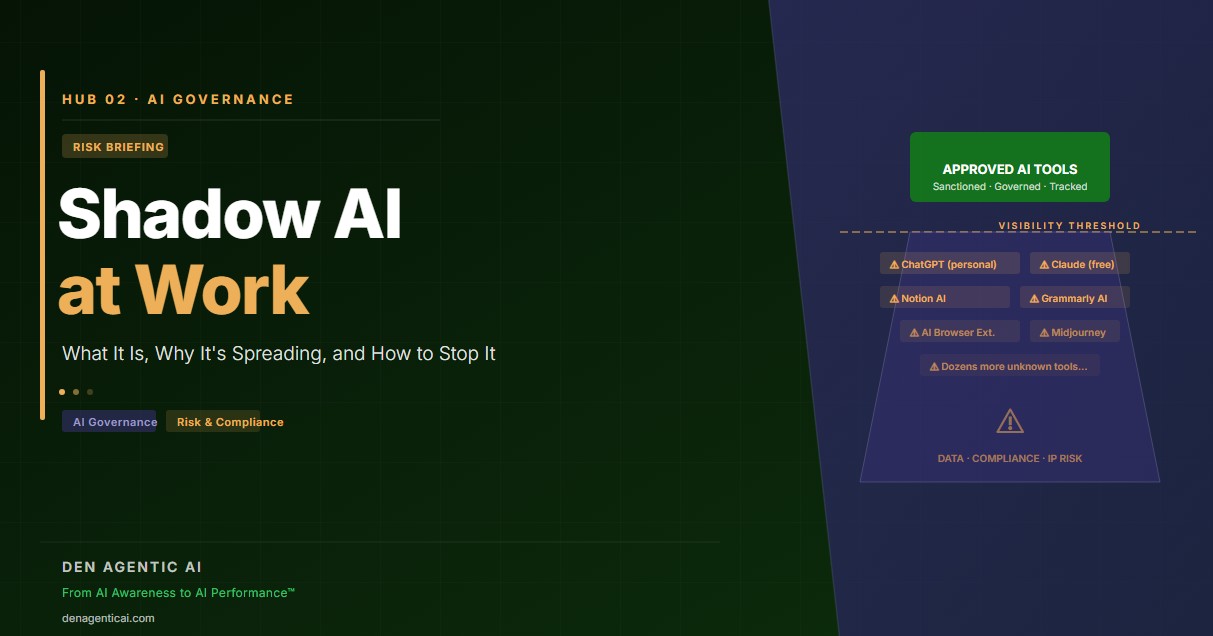
Shadow AI is the use of artificial intelligence tools by employees without the knowledge, authorization, or governance oversight of their organization’s leadership. It is the AI equivalent of “shadow IT” — the unauthorized use of software that IT teams never approved — and in 2026, it is one of the most widespread and underacknowledged operational risks in mid-market organizations.
This post explains what shadow AI looks like in practice, why it’s spreading faster than most leadership teams realize, and the specific steps you can take to address it without slowing down your team’s legitimate AI productivity.
What Is Shadow AI?
Shadow AI occurs whenever an employee uses an AI tool — ChatGPT, Microsoft Copilot, Google Gemini, a browser-based writing assistant, or any other AI product — in a work context without:
- Explicit organizational authorization for that tool
- A written rule about which data can be entered into that tool
- A process for reviewing AI outputs before they reach clients or are acted upon
- A named person accountable for what that tool can and cannot do
Shadow AI is not a story about malicious behavior. The vast majority of employees using AI tools without authorization are doing so because they’ve discovered a genuine productivity benefit — and because no one has given them guidance about the boundaries.
The problem is not the intent. The problem is the exposure.
Why Shadow AI Is Spreading in 2026
Deloitte’s 2026 AI Institute research confirmed a pattern that many operations leaders had quietly suspected: the majority of organizations where leadership believes “we haven’t started with AI” have employees actively using AI tools.
The reason is structural. Consumer AI tools are:
- Free or low-cost — no budget approval required
- Immediately accessible — available in any browser, on any device
- Genuinely useful — they do accelerate routine writing, research, and summarization
- Invisible to IT — they leave no procurement footprint and often no audit trail
This creates a gap between what leadership believes about AI use and what is actually happening. And that gap is precisely where the governance risk lives.
What Shadow AI Looks Like in a 100-Person Organization
The pattern documented in Deloitte’s research is consistent and recognizable:
Month 1: Two or three high performers discover that ChatGPT dramatically accelerates draft writing and client email responses. They begin using it daily.
Month 2–3: Word spreads. Usage grows to 8–10 people. Each person is making their own judgment about what data is appropriate to enter.
Month 4: A client asks about the firm’s AI and data handling practices. Leadership discovers the situation mid-conversation.
Month 5: Legal reviews the situation. At least two instances of client-identifying information were entered into a public AI model. The tool was not on any approved list. No data classification rule existed.
This is not a worst-case scenario. It is the scenario documented repeatedly in 2026 governance research.
The 4 Specific Risks of Unmanaged AI Use
Risk 1: Client Data in Public AI Models
Consumer AI tools — unless enterprise versions with data processing agreements are purchased — may train on user inputs or transmit them to third-party servers. When employees enter client data, employee data, or financial information into these tools, that data leaves the organization’s control.
Risk 2: AI-Generated Content Reaching Clients Without Review
AI language models generate plausible-sounding content. They also generate factual errors, misquotations, and hallucinations with the same confident tone. Without a review process, AI-generated content reaches clients unchecked — and errors are discovered after they damage the client relationship.
Risk 3: Contractual Exposure
Many client contracts include data handling clauses that prohibit sharing client information with third parties. An AI tool whose terms of service allow data to be used for model training may constitute a third-party data share. Most organizations have never reviewed their client contracts through this lens.
Risk 4: Inconsistent Output Quality
Different employees using different AI tools with different prompting approaches produces inconsistent quality. The organization cannot maintain service standards it cannot see or measure.
Risk 5: Regulatory and Legal Exposure
AI-specific regulation is landing in both the US and Canada. Organizations using AI tools in employment decisions face EEOC scrutiny under existing anti-discrimination law — the EEOC has been explicit that Title VII applies to AI-influenced hiring decisions, and organizations with shadow AI in their hiring workflow typically have no documentation to demonstrate they assessed the tool for discriminatory outcomes before use. Similarly, CFPB guidance applies existing consumer financial law to AI-mediated credit decisions. Colorado’s automated decision-making law (effective January 2027) will require impact assessments and consumer disclosures for AI used in consequential decisions — documentation that is impossible to produce retroactively for tools adopted without governance. In Canada, PIPEDA penalties up to C$100,000 apply to personal data mishandled through AI systems; Quebec’s Law 25 adds additional obligations where automated decisions significantly affect individuals. Shadow AI — by definition undocumented and ungoverned — makes every one of these compliance obligations harder to meet.
How to Address Shadow AI Without Shutting Down Productivity
The instinct to “ban AI tools” is counterproductive and practically ineffective. Employees who find genuine productivity value in AI tools will find ways to continue using them. The right approach is to bring shadow AI into the light — not to extinguish it.
Step 1: Run the Governance Assessment. Before writing any policy, understand the current state. The free Governance Assessment at DEN Agentic AI maps which governance elements are missing and where the exposure is greatest.
→ Take the free Governance Assessment →
Step 2: Name an AI Governance Owner. One person — not a committee — accountable for AI decisions and incidents. They need decision authority, not technical expertise.
Step 3: Publish an Approved Tools Register. A spreadsheet listing every AI tool permitted for business use, with approved use cases and data restrictions. Start with the tools people are already using.
Step 4: Write a Data Classification Rule. One clear written statement: which categories of data cannot enter any AI tool without explicit approval. Start with client data, employee data, and financial data.
Step 5: Define a Three-Tier Output Review Process.
- Tier 1 (internal, low consequence): Employee self-review
- Tier 2 (client-facing, moderate): Supervisor review before sending
- Tier 3 (legal, HR, financial, regulatory): Expert sign-off before use
These five steps are the minimum viable response to active shadow AI. They don’t require a consultant. They require one meeting, one document, and one decision.
→ Full guide: How to build an AI governance framework →
→ Download the free Responsible AI Use Policy Starter Template →
→ Return to Hub 2: The Complete Guide to AI Governance →
Frequently Asked Questions
Q: What is shadow AI? Shadow AI is the use of AI tools by employees without organizational authorization, a governance policy, or oversight from leadership or IT. It occurs without data classification rules, approved tool lists, or output review processes in place.
Q: Is shadow AI illegal? Shadow AI is not inherently illegal, but it can create legal exposure — particularly when client data enters AI tools that may use it for model training, or when AI-generated content violates client contract terms. The exposure is primarily contractual and reputational.
Q: How common is shadow AI? Deloitte’s 2026 AI research found shadow AI is the norm, not the exception, in mid-market organizations. Most organizations where leadership believes AI adoption hasn’t started have employees using AI tools individually without governance.
Q: What’s the difference between shadow AI and shadow IT? Shadow IT refers to any unauthorized software or technology use. Shadow AI is specifically the unauthorized use of AI tools — with particular risks around data handling, output quality, and contractual obligations.
Q: How do I find out if my organization has shadow AI? The most reliable method is a direct team survey: which AI tools does each team member use in daily work, for what purposes, and how frequently? Leaders are often surprised by the volume and range of AI tools already in use. The Governance Assessment at DEN Agentic AI is designed to surface this gap systematically.
Q: Can I stop shadow AI by blocking websites? Website blocking is largely ineffective — employees can access consumer AI tools on personal devices or through mobile data. The effective response is to provide clear authorization (approved tools register), clear boundaries (data classification rule), and a safe reporting path — not prohibition.