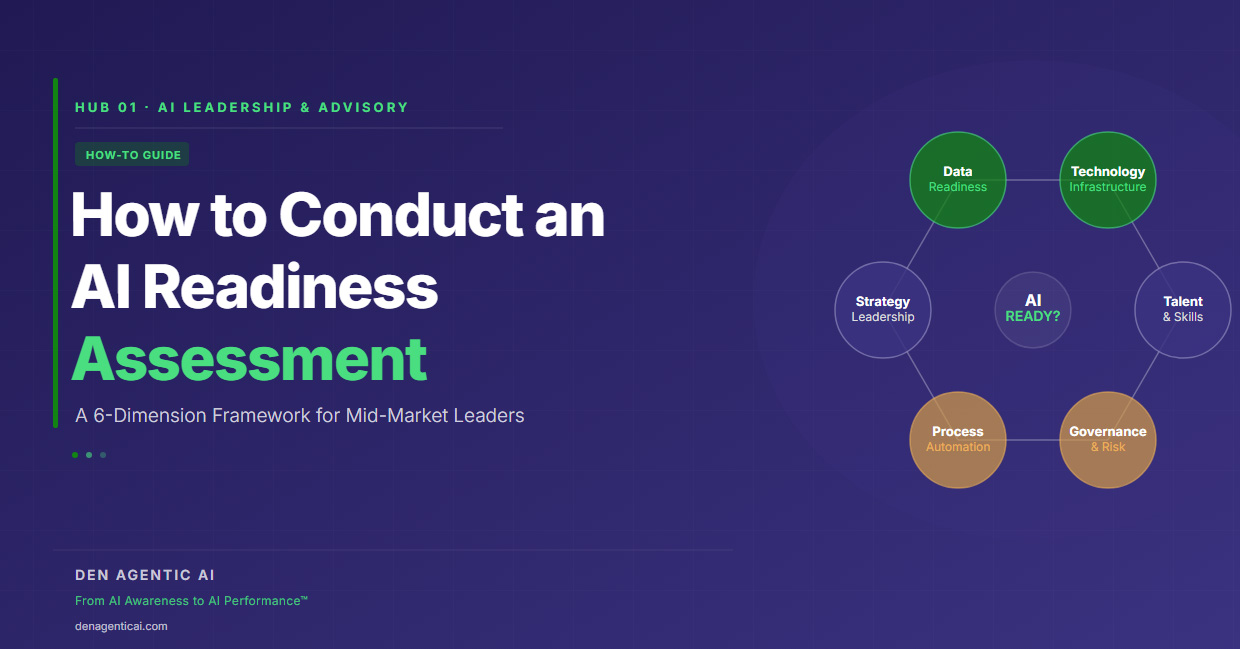
An AI readiness assessment is a structured evaluation of an organization’s current capability across the six dimensions that determine whether AI initiatives will succeed: AI Strategy, AI-Ready Data, Tools & Technology, People & Capability, Governance & Risk, and Automation Readiness.
The output of an AI readiness assessment is not a single pass/fail verdict. It is a dimensional profile — showing strengths, gaps, and the specific ceiling dimension that is most limiting the organization’s AI potential.
Why Every AI Initiative Should Begin with an Assessment
The most common framing of AI readiness is wrong. Most organizations treat it as a binary question: “Are we ready for AI?” The real question is: “What are we ready for — and what are we not ready for yet?”
This reframing matters because:
You are almost certainly ready for something. Almost every organization — even those at Level 1 AI maturity — can implement Q1 AI Assist tools safely and productively.
You are almost certainly not ready for something else. Almost every organization has at least one dimension that would generate significant risk if an AI initiative in that direction were deployed without preparation. The assessment identifies that dimension before, not after, investment is committed.
→ Understand the 6 AI maturity levels →
The 6 Dimensions: What You Are Evaluating
Dimension 1: AI Strategy
Can you describe your organization’s AI direction in one sentence — with a named owner and an approved budget?
Level 1 indicators: No formal AI direction. Leadership discussing AI but no owner named and no budget allocated. Level 3 indicators: A named executive owns AI outcomes. AI connects to at least one top business priority. A use case selection process exists.
Dimension 2: AI-Ready Data
Is the data your first AI use case requires clean, accessible, and in a usable format?
Level 1 indicators: Data sits in disconnected spreadsheets and silos. No central data dictionary. No data owner. Level 3 indicators: Core business metrics are consistently defined. Primary data sources are monitored for quality. Key internal documents are version-controlled and accessible.
Dimension 3: Tools & Technology
Do your systems support AI deployment — including cloud infrastructure, APIs, and integration endpoints?
Level 1 indicators: All systems are on-premise or in legacy applications with no API access. Level 3 indicators: Key systems are accessible via APIs. Cloud or hybrid infrastructure is established. The organization can support RAG deployment with minor preparation.
Dimension 4: People & Capability
Can your team use AI tools deliberately — prompting effectively, verifying outputs, and identifying AI limitations?
Level 1 indicators: Zero AI awareness. No employee can evaluate an AI output for accuracy. Level 3 indicators: AI literacy has spread to team leaders and key functions. Business sponsors (not just IT) own AI initiatives.
Dimension 5: Governance & Risk
Do you have a written AI use policy, a named governance owner, and a defined output review process?
Level 1 indicators: No AI policy. No approved tools list. No awareness of what tools employees are using. Level 3 indicators: A written AI usage policy is approved and communicated. An approved tool list exists. A named governance owner is in place. An output review habit is established for client-facing content.
Dimension 6: Automation Readiness
Do your systems support read-write API access and trigger-action workflow automation?
Level 1 indicators: Systems do not connect via API. Data is moved manually. No team member has experience with workflow automation tools. Level 3 indicators: Core business systems support read-write API access. At least one team member has workflow automation experience. An integration platform (n8n, Make, Zapier) is in use or planned.
How to Conduct the Assessment: 4 Steps
Step 1: Assess independently, then convene. Each leadership team member should score the six dimensions independently before a group session. Independent scoring reveals disagreements that group discussions tend to suppress toward a consensus that flatters the organization.
Step 2: Score each dimension from 0 to 5 with evidence. For each dimension, record one or two observable behaviors that justify the score. Scores without evidence are opinions. Scores with documented evidence are diagnostics.
Step 3: Identify the ceiling dimension. The lowest-scoring dimension is your ceiling. This single dimension defines which AI initiatives are safe to pursue at this time — regardless of how other dimensions score. An organization that scores Level 4 in five dimensions but Level 1 in Governance is a Level 1 organization for governance-sensitive initiatives (which is most of them).
Step 4: Run the sanity check. Before finalizing the profile, ask: “If we tried to deploy our first Q2 automation today, what would stop us?” If the answer is something not reflected in your scores, the scores need revisiting.
Three Ways to Complete the Assessment
Option 1 — Free AI Readiness Check (3 minutes): A self-assessment scoring all 6 dimensions. Identifies your maturity level and ceiling dimension automatically. → Take the Free AI Readiness Check →
Option 2 — Free Governance Assessment (5 minutes): Focused specifically on the governance dimension — the most common ceiling — with a gap analysis against the four minimum viable governance elements. → Take the Governance Assessment →
Option 3 — Facilitated Assessment (Full): A 60–90 minute structured session with your leadership team. Produces a written AI Maturity Diagnostic Report with your ceiling identified and your eligible initiative categories defined. → Book a free consultation →
What to Do with the Results
If your ceiling is Governance & Risk (most common): Your first priority is building minimum viable governance — naming an owner, publishing an approved tools register, writing a data classification rule, and implementing a three-tier output review policy. This takes two weeks. → How to build an AI governance framework →
If your ceiling is AI-Ready Data: Your first priority is a data audit — identifying which data sources your first AI use case requires and mapping them against accessibility and quality criteria.
If your ceiling is Tools & Technology: Assess API accessibility of your top 3 source systems before selecting any AI use case that requires integration.
If your ceiling is People & Capability: A targeted AI literacy programme for team leaders is the prerequisite for any pilot — even Q1 initiatives require employees who can evaluate AI outputs critically.
→ Return to Hub 1: The Complete Guide to AI Strategy →
Frequently Asked Questions
Q: How do you assess AI readiness? Score your organization across six dimensions (AI Strategy, AI-Ready Data, Tools & Technology, People & Capability, Governance & Risk, Automation Readiness) using observable evidence. Identify the lowest-scoring dimension — your capability ceiling. Design your AI advancement plan around closing the ceiling gap.
Q: What is an AI readiness assessment? A structured evaluation of an organization’s capability to deploy AI successfully. The output is a dimensional maturity profile identifying strengths, gaps, and the specific ceiling dimension that is most limiting AI potential.
Q: How long does an AI readiness assessment take? The free self-assessment (AI Readiness Check) takes 3 minutes. The governance-specific assessment takes 5 minutes. A full facilitated assessment with a leadership team takes 60–90 minutes and produces a written Diagnostic Report.
Q: What is the most common ceiling dimension in mid-market AI readiness assessments? Governance & Risk — the absence of a written AI use policy, a named governance owner, and an approved tools register. This single gap prevents organizations from safely advancing to deliberate AI pilots even when they have strong strategy, data, and technology scores.
Written by Tariq Alam, Founder of DEN Agentic AI. Take the free AI Readiness Check at denagenticai.com/ai-readiness-check. Book a free consultation at denagenticai.com/ai-readiness-consultation