The AI Maturity Model Explained: 6 Levels Every Business Leader Needs to Know
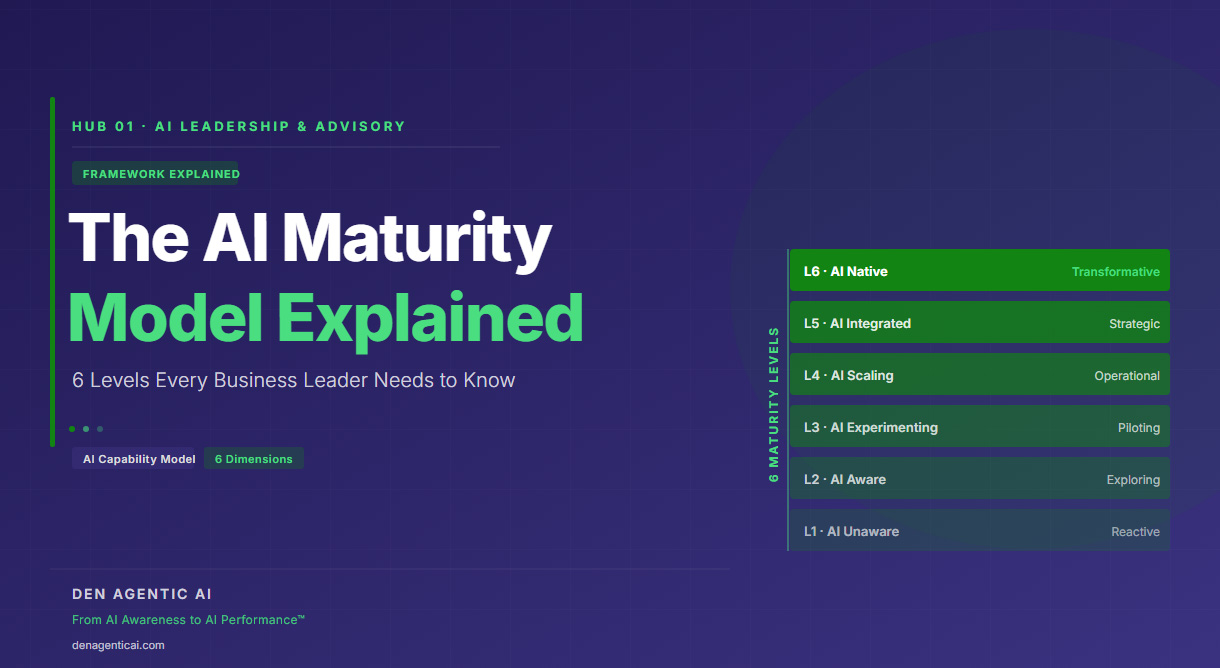
An AI maturity model is a structured framework that describes the stages of organizational capability in deploying, governing, and scaling artificial intelligence. It defines what each stage of capability looks like in practice, what distinguishes one level from the next, and what initiatives are appropriate — and inappropriate — at each stage.
For mid-market business leaders, the AI maturity model answers the most important question in AI strategy: not “which AI tool should we buy?” but “what level are we at, and what does the next level require?”
Why the AI Maturity Model Matters More Than Tool Selection
This is the finding that McKinsey, BCG, and Gartner each arrived at independently in their 2025–2026 AI research:
AI adoption success is predicted by organizational maturity, not tool selection.
A Level 1 organization deploying a Level 4 tool does not become Level 4. It becomes Level 1 with an expensive, underused tool — and a leadership team that is now skeptical of AI entirely.
The tool does not raise your maturity. The structured work to prepare your strategy, data, technology, people, and governance does.
Understanding your maturity level is the prerequisite to every other AI decision.
The 6 Levels of AI Maturity
Level 0 — Pre-Adoption
Definition: The organization has no formal or informal AI activity.
What it looks like in practice:
- No employees are formally using AI for work tasks
- Leadership has not yet discussed AI adoption, prioritization, or strategy
- Data exists in legacy systems with no consideration for AI retrievability
Appropriate AI initiatives: None yet. The priority is leadership education, strategic alignment, and initial opportunity mapping.
What prevents advancement to Level 1: Lack of internal awareness or a champion to initiate early experiments.
Level 1 — Ad Hoc
Definition: AI use is uncoordinated, individual-led, and ungoverned.
What it looks like in practice:
- 2–5 team members use generic consumer AI tools (e.g., ChatGPT, Copilot) independently
- No written AI policy or approved tools register exists — the classic “Shadow AI” pattern
- Leadership is discussing AI, but no formal budget or owner has been named
- Data quality is variable and access is fragmented
Appropriate AI initiatives: Q1 AI Assist tools only — individual productivity tasks with human review of every output. No automation. No customer-facing applications.
What prevents advancement to Level 2: The absence of a governance framework (the most common ceiling) and the lack of a named AI owner.
Level 2 — Exploratory
Definition: AI use is becoming deliberate, and early pilots are beginning.
What it looks like in practice:
- At least one deliberate AI pilot is underway (approved, scoped, with defined success metrics)
- A corporate AI use policy is in draft, and a named AI Governance Owner has been identified
- Core systems are being assessed for API connectivity
- Early AI literacy training is planned or in progress
Appropriate AI initiatives: Deliberate Q1 pilots with structured prompting and output review processes. First governance milestones being met.
What prevents advancement to Level 3: Fragmented data quality, incomplete governance, and lack of API integration readiness.
Level 3 — Operational
Definition: AI is integrated into daily operational workflows with defined approval paths.
What it looks like in practice:
- At least one AI tool is in daily operational use with tracked KPIs
- A written AI use policy and approved tools register are finalized and enforced
- Key teams have practical AI skills, and data definitions are standardized
- The organization is ready to move beyond assistants into internal automation (Q2)
Appropriate AI initiatives: Q1 and Q2 initiatives in production. Automated internal monitoring and exception handling.
What prevents advancement to Level 4: Lack of systematic ROI tracking, limited API automation infrastructure, and lack of customer-facing QA protocols.
Level 4 — Managed
Definition: AI is embedded in core workflows, measured systematically, and managed as a strategic asset.
What it looks like in practice:
- Multiple AI tools in operational use with tracked outcomes and ROI
- Successful Q2 automation deployments running with supervisor checkpoint reviews
- Governance is tiered by risk with audit trails and incident response procedures
- The organization is exploring its first Q3 (Growth Augmentation) initiatives
Appropriate AI initiatives: Q2 and Q3 in production. Q4 autonomous client-facing pilots under close monitoring.
What prevents advancement to Level 5: Lack of a unified semantic data layer and multi-agent orchestration capabilities.
Level 5 — Transformational
Definition: AI is core to how the organization operates, delivers value, and competes.
What it looks like in practice:
- AI capabilities are a recognized competitive differentiator
- The AI portfolio spans Q1, Q2, Q3, and Q4 initiatives, including autonomous client-facing applications
- Governance is a board-level agenda item with automated compliance and policy audits
- Multi-agent orchestration and Agentic Knowledge Engines (AKE) are operational
Appropriate AI initiatives: Full Q1–Q4 portfolio. Custom AI developments and agentic workflow orchestration.
Important note: Most mid-market organizations should target Level 3 (Operational) as a realistic 12-month goal. Level 4–5 requires extensive data and integration engineering investment.
The Ceiling Dimension Problem
The maturity model becomes most strategically useful when it reveals the ceiling dimension — the single AI readiness dimension that is most limiting your organization’s overall maturity.
An organization’s overall AI maturity level is determined by its lowest-scoring dimension, not its average.
For example, an organization might score:
- AI Strategy: Level 3
- AI-Ready Data: Level 3
- Tools & Technology: Level 2
- People & Capability: Level 2
- Governance & Risk: Level 1 ← CEILING
- Automation Readiness: Level 2
This governance ceiling means the organization cannot responsibly advance to Level 2 overall — regardless of how strong the strategy or data quality dimensions are — until the governance gap is closed.
Every investment made in AI initiatives before the ceiling is addressed will underperform. Not because the initiatives are wrong, but because the foundational limitation remains unresolved.
Identifying your ceiling dimension is the single most valuable output of an AI readiness assessment.
How to Determine Your Organization’s AI Maturity Level
Step 1: Assess each of the 6 dimensions independently. Score each dimension from Level 0 to Level 5. The full AI Capability Maturity Model provides the scoring criteria for each dimension.
Step 2: Identify your ceiling dimension. The lowest-scoring dimension is your ceiling. It defines the practical limit of your overall maturity — regardless of how other dimensions score.
Step 3: Design your advancement plan around the ceiling. The path to the next level is about closing the specific gaps your ceiling dimension has identified — not buying a new AI tool.
Quick option: The AI Readiness Check at DEN Agentic AI scores your organization across all 6 dimensions in 3 minutes and identifies your ceiling dimension automatically.
→ Take the Free AI Readiness Check
The full AI Capability Maturity Model — covering all 6 dimensions, all 6 levels, and the appropriate initiatives at each stage — is a free PDF download.
→ Download the AI Capability Maturity Model PDF
→ How to conduct a full AI readiness assessment →
→ Return to Hub 1: The Complete Guide to AI Strategy →
Frequently Asked Questions
Q: What is an AI maturity model? An AI maturity model is a framework that describes the stages of organizational capability in deploying, governing, and scaling AI. It defines what each stage looks like in practice, what distinguishes one level from the next, and what AI initiatives are appropriate at each stage.
Q: How many levels are in the DEN Agentic AI maturity model? The DEN AI Capability Maturity Model uses 6 levels: Level 0 (Pre-Adoption), Level 1 (Ad Hoc), Level 2 (Exploratory), Level 3 (Operational), Level 4 (Managed), and Level 5 (Transformational).
Q: What AI maturity level should a mid-market organization aim for? For a 50–500 person organization, Level 3 (Operational) is a realistic and meaningful 12-month target. This means at least one AI tool in daily operational use with tracked KPIs, a finalized governance framework, and standardized data definitions.
Q: Why does AI maturity matter more than AI tool selection? Because an organization’s maturity determines whether the AI tool will be adopted, used correctly, governed responsibly, and maintained over time. Matching tool ambition to organizational maturity is what separates successful AI adoption from failed pilots.
Q: What is the most common AI maturity level for mid-market organizations in 2026? Based on Gartner’s AI maturity research, the majority of mid-market organizations are at Level 1 (Ad Hoc) or Level 2 (Exploratory). The largest single gap that keeps organizations at Level 1 is the governance dimension.
Written by Tariq Alam, Founder of DEN Agentic AI. Download the free AI Capability Maturity Model PDF at denagenticai.com/resources. Book a free consultation at denagenticai.com/ai-readiness-consultation