
An AI strategy is a documented plan that defines what artificial intelligence your organization will deploy, in what sequence, governed by which rules, and measured by which outcomes — aligned to your actual maturity and your specific business priorities.
Without one, mid-market organizations follow the same predictable failure path: a tool is purchased under vendor or board pressure, adoption stalls within 90 days, leadership loses confidence, and the organization becomes cautious about AI investment at precisely the moment when their competitors are accelerating.
This guide gives you the complete framework for building an AI strategy that avoids this pattern — from assessing your readiness to prioritizing your initiatives, governing them responsibly, and measuring results in terms a CFO will approve.
Why Mid-Market Organizations Need a Formal AI Strategy
Mid-market organizations — those with 50 to 500 employees — face a specific AI adoption challenge that neither small businesses nor enterprises fully share. Small businesses can experiment cheaply, often with a single decision-maker who can pivot quickly. Enterprises have dedicated AI teams, formal innovation governance, and access to Big 5 advisory firms to guide their approach.
Mid-market organizations operate between these two realities:
- Enough scale to be exposed. Operations, client deliverables, and compliance obligations are complex enough that AI errors cause real damage — to clients, to staff, to regulatory standing.
- Not enough resources for enterprise-grade advisory. A $500,000 AI implementation project is not a realistic option. Every dollar deployed needs to be justified, and every failed pilot sets back organizational confidence.
- Vendor pressure without strategic guidance. Software vendors are aggressively pitching AI features to mid-market buyers — without helping them understand whether their organization is ready to use those features effectively.
The result is documented in every major 2025–2026 AI research report from McKinsey, PwC, Deloitte, BCG, and Gartner: most mid-market organizations are either over-purchasing AI tools they cannot fully utilize, or under-investing in AI out of caution while their competitors move forward. A formal AI strategy closes this gap. It answers four questions every mid-market leader must resolve before writing a single technology purchase order:
- Which AI opportunities are right for our organization? (Opportunity classification)
- What is our current capability to execute them? (Readiness assessment)
- Which AI initiatives should we prioritize first? (Scored prioritization)
- How will we govern, measure, and scale what we build? (Governance and Roadmapping)
The 7-Step DEN AI Strategy Framework
The DEN Agentic AI advisory engagement follows a structured seven-step framework that addresses each of these questions in a disciplined sequence. Each step produces a concrete deliverable — not a slide deck, but a working tool your team can act on immediately.
- Four Quadrants of AI Value – Classified opportunity list
- AI Capability Maturity Model – Dimensional maturity profile + capability ceiling
- Use Case Prioritisation Scorecard – Scored, ranked initiative list
- Strategic AI Initiative Canvas – Fully-specified technical blueprint
- AI Governance Framework – Risk Tiering Register, Approved Tools Register, AI Use Policy, Accountability Design
- KPI Design + Cost Model – KPI baselines, Cost Envelope, ROI model (60% rule)
- 90-Day AI Roadmap – Phased execution plan with gate decisions
Each of these frameworks is available as a self-service tool at denagenticai.com/resources. The advisory engagement applies all seven in sequence with a structured facilitated process.
Step 1 — Classify Your Opportunities: The Four Quadrants of AI Value
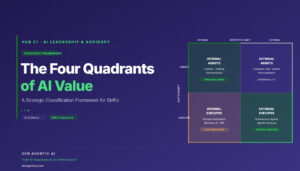
Before evaluating any AI tool or use case, every candidate initiative should be classified using the Four Quadrants of AI Value — a two-axis framework that maps AI opportunities by who benefits and how much autonomy the AI operates with.
Axis 1: Value Beneficiary
- Internal — The improvement occurs within the organization (employees work faster, internal friction is reduced)
- External — The improvement is visible to clients or customers (embedded in deliverables, sales interactions, or customer support)
Axis 2: AI Autonomy Level
- AI Assists — The AI acts as a drafting partner or research assistant; a human reviews every output before it is used
- AI Executes — The AI takes actions autonomously in a workflow; outputs are acted on without prior human review of every instance
This produces four quadrants, each with distinct maturity requirements, governance implications, and expected ROI timelines:
- Q1 — Workforce Productivity (Internal + Assists): AI tools that help employees work faster. Drafting, summarizing, researching, formatting. Lowest risk. Safe to start at Level 1 maturity. Fastest adoption. Examples: AI writing assistants, meeting summarizers, internal knowledge retrieval.
- Q2 — Operational Efficiency (Internal + Executes): AI that automates internal workflows without requiring human approval of every step. Email routing, data transformation, report generation. Requires Level 2–3 maturity, API-connected systems, and governance clarity. Examples: n8n workflow automation, CRM data hygiene, invoice processing.
- Q3 — Revenue Growth (External + Assists): AI embedded in client-facing work — proposal drafting, insight generation for client reports, personalized communications. Requires Level 3 maturity, strong output review policy, and legal awareness. Examples: AI-assisted proposal generation, client brief analysis, sales intelligence.
- Q4 — Autonomous Customer Experience (External + Executes): AI that operates in real time with external stakeholders — chatbots, autonomous scheduling, AI-mediated client onboarding. Requires Level 4 maturity, robust data quality, strong governance, and full legal review. Examples: client-facing chatbots, automated intake processing, AI support agents.
→ Deep dive: The Four Quadrants of AI Value — full framework guide →
Step 2 — Assess Your Readiness: The AI Capability Maturity Model
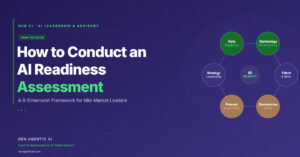
Once you have a classified opportunity list, you need to know which quadrants your organization is actually ready to execute in. This requires an honest assessment against the AI Capability Maturity Model — a five-level, six-dimension diagnostic framework.
The Six Levels:
- Level 1 (Ad Hoc): Individual AI use exists but is ungoverned and unmeasured.
- Level 2 (Exploratory): Deliberate pilots are beginning. Growing awareness but no formal process.
- Level 3 (Operational): Defined, documented process for selecting and governing AI use cases. Active pilots in daily use.
- Level 4 (Managed): AI embedded in core workflows. Value is tracked and reported to leadership.
- Level 5 (Transformational): AI directly shapes how the organization competes in its market.
The Six Dimensions (evaluated independently): Strategy · AI-Ready Data · Tools & Technology · People & Capability · Governance & Risk · Automation Readiness
The Ceiling Rule — the framework’s most important principle: Your effective maturity level is not an average of the six dimensions. It is the lowest dimension score among those relevant to a given initiative. An organization that scores Level 4 in five dimensions but Level 1 in Governance is a Level 1 organization for any initiative that requires governance — which is most of them.
This rule explains why so many mid-market AI pilots fail: organizations overestimate their readiness because they are measuring capability but ignoring their ceiling.
→ Understand your maturity level: The AI Capability Maturity Model explained →
→ Conduct your assessment: How to do an AI readiness assessment →
→ Take the free AI Capability Maturity Assessment (3 minutes) →
Step 3 — Prioritize Your Initiatives: The 6-Criterion Scorecard
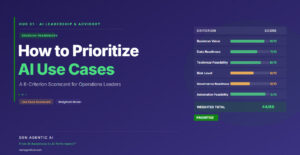
With your opportunity list classified and your maturity profile completed, you can now rank your eligible initiatives against each other. The Use Case Prioritisation Scorecard scores each initiative on six weighted criteria:
| Criterion | Weight | What It Measures |
|---|---|---|
| Business Value | 30% | Expected impact on revenue, cost, or risk |
| Data Readiness | 25% | Whether the data required for this initiative exists in usable form |
| Technical Feasibility | 20% | API access, integration complexity, vendor readiness |
| Risk Level | 15% | Consequence of error, regulatory exposure, data sensitivity |
| Governance Readiness | 10% | Policy clarity, output review structure, accountability |
Any initiative that scores below 3.0 (out of 5.0) on Data Readiness or Governance Readiness is blocked until those dimensions are resolved — regardless of its business value score. A high-value initiative built on poor data or without governance is a high-value failure.
The top-scoring initiative within your maturity ceiling becomes your first pilot. Second and third become your pipeline for Months 4–9.
→ Full guide: How to prioritize AI use cases →
→ Try the free Use Case Prioritisation Scorer →
Step 4 — Specify the Initiative: The Strategic AI Initiative Canvas
Once your first initiative is selected, it must be fully specified before any budget is committed or development work begins. The Strategic AI Initiative Canvas is an 8-component specification framework that forces every critical assumption to be documented before the pilot begins.
The Canvas has eight components. This step covers the five that define the technical specification of the initiative. The remaining three — Governance & Risk Tier, KPI & Success Metrics, and Cost Envelope — are each significant enough to require their own dedicated steps, and are addressed fully in Steps 5 and 6.
The five specification components:
- Business Problem Statement — with a specific number (e.g., “proposal drafts currently take 4 hours; target is 45 minutes”). Vague problem statements produce vague pilots. Every Canvas begins with a quantified current state and a quantified target.
- AI Application Design — the step-by-step workflow with trigger events, decision points, handoff rules, and error paths. This is not a high-level description — it is a sequence diagram in prose that any technical team can build from.
- Data Source & Quality — the exact source system, access method (API, database query, file export), update frequency, and known data quality issues. If the data source cannot be named precisely, the initiative is not ready to proceed.
- Human Review Design — who reviews which outputs, at which governance tier, within what time window, and using what criteria. Human review is not optional at any risk tier — it varies only in frequency and formality.
- Pilot Scope — one team, bounded volume, 30-day go/no-go gate. Every pilot is constrained in scope. Expanding scope before the gate decision is the most common cause of inconclusive pilots.
An initiative that cannot fully complete the Canvas before launch is not ready to launch. Incomplete specification is the leading cause of AI pilot failure — not technology.
→ Download the Strategic AI Initiative Canvas (free PDF) →
Step 5 — Govern Before You Build: The AI Governance Framework
Before the first line of code is written and before any pilot begins, a governance framework must exist. The AI Governance Framework is a constitutional document — the rules of the road for everything that follows. It is not a compliance exercise. It is the prerequisite infrastructure that determines whether your AI initiatives succeed or fail in production.
Organizations that defer governance to Phase 2 — “we will figure it out once we see how it works” — consistently produce the same outcome: incidents, shadow AI proliferation, and leadership confidence collapse. Governance is Phase 1.
The DEN Risk Tiering Model
Every active and planned AI use case is classified across three tiers, with proportional oversight requirements:
- Tier 1 — Low Risk: AI operating on non-sensitive internal data with no autonomous decisions. Examples: internal document summarization, meeting transcription, writing assistance. Requires: approved tool listing, basic use policy acknowledgement.
- Tier 2 — Medium Risk: AI processing operational data or automating internal workflows. Examples: CRM data automation, internal report generation, workflow routing. Requires: Tier 1 controls plus a documented output review process, named accountability owner, and data classification confirmation.
- Tier 3 — High Risk: AI taking actions with external impact or processing sensitive or regulated data. Examples: client-facing AI agents, automated contract processing, HR decision support, financial data analysis. Requires: Tier 1 and 2 controls plus legal review, Human-in-the-Loop checkpoints at every decision node, a tested incident response playbook, and override rate monitoring.
The tier classification feeds directly into Canvas component 5 (Governance & Risk Tier) and determines the Human Review Design specified in component 4.
The Four Governance Instruments
The AI Governance Framework document delivers four instruments that must be in place before any pilot launches:
- Approved Tools Register — a documented list of all approved AI tools by category and permission level: who can use what, for what purpose, with what data. Any tool not on the register is classified as shadow AI, regardless of how widely it is being used.
- AI Use Policy — written policy covering acceptable use cases, data handling rules by tool category, output review requirements by governance tier, and what constitutes a reportable incident. Ideally one to two pages — specific enough to be actionable, short enough to be read.
- Data Classification Rule — defines which categories of organizational data can be processed by which tier of AI tool. This single rule prevents the most common governance incident: Tier 1 tools being used with Tier 3 data because nobody documented the boundary.
- Accountability Design — names the AI Governance Owner, defines escalation paths for each tier, and specifies who has sign-off authority for new tool approvals and incident responses.
What this framework is — and what comes later
This governance framework is the constitutional document: designed before any system is live, for a board and leadership audience. It defines the rules. A second document — the AI Operations Governance Manual — is built after systems are live and governs running workflows: live registries, credential rotation schedules, tested incident response playbooks, and override rate monitoring. The two documents are fundamentally different instruments and should never be presented as duplicative work.
→ Full guide: How to build an AI governance framework →
→ Take the free AI Governance Assessment (4 minutes) →
→ Check your shadow AI exposure: Shadow AI Pulse Check →
Step 6 — Measure and Cost: KPI Design and ROI Modelling
An AI initiative without pre-defined, baseline-measured KPIs is ungovernable. You cannot demonstrate ROI you did not measure before Day 1. You cannot make a credible gate decision at Day 30 without a baseline against which to compare. Measurement design and cost modelling happen before the pilot — not after it.
The Three-KPI Model
Every AI initiative is measured against three categories of KPI, each capturing a different dimension of performance:
- Outcome KPI: The business result the initiative is designed to produce. Expressed as a current state and a target state with a specific number: “Proposal drafts take an average of 4 hours; target is 45 minutes.” This is the ROI-bearing metric — revenue impact, cost reduction, or risk reduction in measurable terms.
- Process KPI: Operational performance of the AI system itself — output volume, processing speed, error rate, escalation rate. These are leading indicators that tell you whether the system is functioning before the business outcome has had time to materialize. If the Process KPI is degrading at Week 3, you can intervene before the gate decision.
- Quality KPI: Output accuracy and appropriateness, measured by human reviewers against a defined rubric. This is where Human Review Design (Canvas component 4) and the governance framework (Step 5) intersect in measurement form. A Quality KPI below threshold is grounds for gate suspension regardless of Outcome KPI performance.
All three baselines are captured before Day 1 of the pilot. If baseline data cannot be collected, the pilot start date moves. Estimating baselines after launch is not a substitute — it is a rationalization.
The Cost Envelope
Every initiative requires a complete cost model before budget approval. Four cost categories, all mandatory:
- Setup Costs: Development, configuration, integration, testing, and initial staff training
- Operations Costs: API fees, platform subscriptions, ongoing maintenance, licensing
- Oversight Costs: Human review time, governance owner time, quality auditing — consistently underestimated and always required for any Tier 2 or Tier 3 initiative
- 20% Contingency: A non-negotiable buffer for integration delays, rework, and error handling. Not a negotiable line item.
The 60% Rule for Board-Defensible ROI
When presenting ROI to leadership or a board, present 60% of the total projected return — not 100%. This practice accounts for implementation variance, adoption curves, and measurement uncertainty. A 60%-presented number that is met or exceeded builds significantly more leadership credibility than a 100%-projected number that falls short by 30%. CFOs who have seen AI project overstatement respond better to a figure that acknowledges the gap between projection and reality before it occurs.
The Board-Ready Package
With Steps 4, 5, and 6 complete, the Strategic AI Initiative Canvas is fully specified:
- Components 1–4 and 8 (Step 4): Technical blueprint — problem statement, workflow design, data sources, human review, pilot scope
- Component 5 (Step 5): Governance — risk tier classification, approved tools, accountability design
- Components 6–7 (Step 6): Measurement and cost — KPI baselines, cost envelope, ROI model
The completed Canvas, the Governance Framework, the KPI baseline document, and the Cost Model together form a board-ready package. Leadership can approve and fund the initiative without the consultant in the room to interpret it.
→ Build your ROI model: How to calculate AI ROI →
→ Full guide: AI KPI design and baseline measurement →
→ Try the free AI ROI Estimator →
Step 7 — Execute and Measure: The 90-Day Roadmap
The 90-Day AI Roadmap sequences your first initiative through three phases — governance foundation, proof of concept, and controlled pilot — with defined milestones and gate decisions at each phase.
Phase 1 — Weeks 1–4: Governance Foundation Close the governance gaps identified in your maturity assessment. Name the AI Governance Owner. Publish the Approved Tools Register. Write the Data Classification Rule. Implement the Three-Tier Output Review Policy. Confirm API readiness for the first use case.
Phase 2 — Weeks 5–8: Proof of Concept Launch the pilot with one team, bounded scope, and 30-day measurement window. Gate decision at Day 30: proceed if actuals are within 80% of KPI projections.
Phase 3 — Weeks 9–12: Controlled Pilot Expand to 2–3 teams. Maintain full measurement. Gate decision at Week 12: production deployment, conditional extension, or initiative suspension.
The gate discipline is what separates organizations that compound AI capability from those that accumulate expensive shelf-ware.
→ Full guide: How to build a 90-day AI roadmap →
Common AI Strategy Mistakes — and How to Avoid Them
Mistake 1: Tool-first thinking. Purchasing a tool before defining the business problem it must solve. The vendor selection process should follow the Canvas specification, not precede it.
Mistake 2: Averaging your maturity score. Treating a dimensional average as your actual readiness level. The Ceiling Rule is not optional — your weakest relevant dimension is your real capability level.
Mistake 3: Planning governance for Phase 2. Starting pilots before governance is established creates incidents that set your AI program back by months. Governance is Phase 1, not Phase 2.
Mistake 4: No baseline measurement. Launching a pilot without measuring the baseline first makes it impossible to calculate real ROI or make a credible gate decision. Baseline measurement happens on Day 1 of every pilot.
Mistake 5: One-and-done pilots. Treating the pilot as the destination. A pilot is a validation step, not a deployment. The ROI materializes in Stage 3 (production deployment), not Stage 1 (PoC). Organizations that abandon initiatives after a single pilot cycle rarely see AI value.
Mistake 6: Shadow AI as the entire AI strategy. Discovering that employees are already using AI tools and treating that as sufficient. Shadow AI is ungoverned, unmeasured, and unscalable. It is a starting condition to address, not an AI strategy.
→ Read more: Shadow AI at work — what it is and how to address it →
How DEN Agentic AI Supports Your Strategy
DEN Agentic AI offers a structured advisory engagement built entirely around the 5-step framework above. Every engagement is fixed-fee, fractional (typically 2–4 days per month), and delivers named, buildable specifications rather than slide decks.
Service 1 — AI Readiness & Maturity Diagnostic (Free): A facilitated assessment session applying the AI Capability Maturity Model across all six dimensions. Output: a written AI Maturity Diagnostic Report with your ceiling dimension identified and your eligible initiative categories defined.
Service 2 — AI Strategy, Prioritisation & Roadmapping (Core): The full 5-step engagement. Covers opportunity classification (Four Quadrants), maturity assessment, use case scoring (Scorecard), initiative specification (Canvas), and roadmap construction (90-Day Plan). Output: a Priority Matrix, Governance Framework, and AI Portfolio Roadmap your team can execute immediately.
→ Book your free 30-minute AI diagnostic consultation →
→ Take the free AI Capability Maturity Assessment to see where you stand today →
Frequently Asked Questions
Q: What is an AI strategy for a business? An AI strategy is a documented plan specifying which AI initiatives an organization will pursue, in what sequence, governed by what policies, and measured by what outcomes — aligned to the organization’s current maturity level and business priorities. For mid-market organizations, an effective AI strategy covers five elements: opportunity classification, readiness assessment, use case prioritization, initiative specification, and a phased execution roadmap.
Q: How long does it take to build an AI strategy? A structured AI strategy for a mid-market organization takes 3–6 weeks to build with advisory support: one week for readiness assessment, one week for opportunity mapping and prioritization, and two to four weeks for initiative specification and roadmap construction. The free AI Readiness Check produces an initial maturity profile in 3 minutes. A full facilitated engagement builds the complete strategy in 4–6 weeks.
Q: What is the most common reason AI strategies fail in mid-market organizations? Tool-first thinking — selecting a technology before defining the business problem, governance structure, and success metrics. The second most common reason is ignoring the Ceiling Rule: organizations deploy initiatives that exceed their actual maturity level, producing pilots that underperform and leadership teams that lose confidence.
Q: Do small businesses need an AI strategy? Any organization deploying AI in a business context — regardless of size — benefits from a structured approach. The complexity and formality of the strategy should scale with organizational size and risk exposure. A 20-person business needs a simpler strategy than a 200-person business, but both need clarity on use case selection, governance, and measurement.
Q: What is the difference between an AI strategy and an AI roadmap? An AI strategy defines what the organization will do with AI and why — opportunity classification, maturity-based initiative selection, and governance commitments. An AI roadmap defines how those decisions will be executed — sequencing, milestones, resource allocation, and gate decisions. Both are required; the strategy precedes the roadmap.
Q: How does AI governance fit into an AI strategy? Governance is not a separate workstream from strategy — it is a prerequisite for strategy execution. The AI Capability Maturity Model scores governance as one of six dimensions that determine your capability ceiling. Without minimum viable governance (named owner, approved tools register, data classification rule), no initiative should proceed to the pilot phase regardless of its strategic value.
→ Read: How to build an AI governance framework →
Related Posts : AI Strategy & Prioritization
- The AI Capability Maturity Model: A Strategic Diagnostic →
- AI Readiness for Mid-Market Organizations: The 2026 Guide →
- How to Conduct an AI Readiness Assessment →
- How to Prioritize AI Use Cases: A 6-Criterion Scorecard →
- How to Calculate AI ROI: A Framework CFOs Will Believe →
- How to Build a 90-Day AI Roadmap →
- The Four Quadrants of AI Value →
- The 5-Phase AI Advisory Journey →