
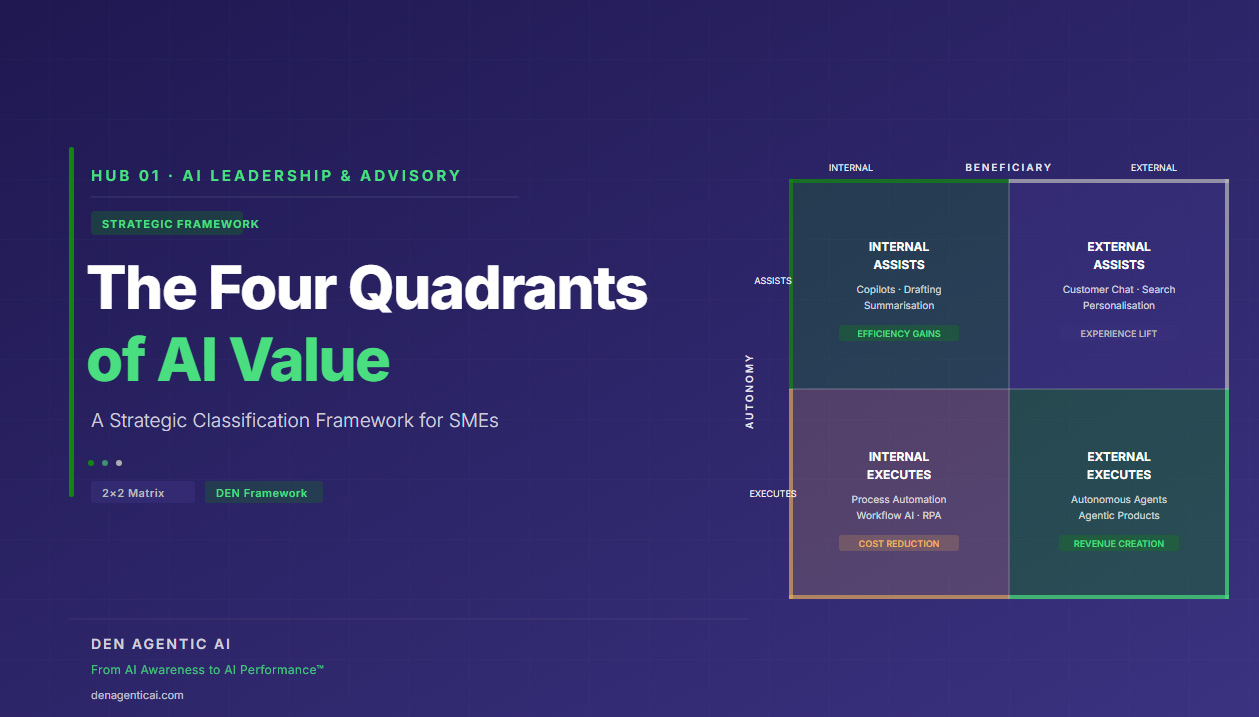
Small and medium-sized enterprises face a specific AI adoption challenge: the volume of potential AI applications is overwhelming, yet resources are constrained. Without a structured method to classify and compare initiatives, organizations fall into “demo-driven prioritization” — attempting high-risk, customer-facing projects before they have the maturity to support them.
The Four Quadrants of AI Value is a two-axis framework designed to solve this problem by classifying every AI initiative based on two fundamental questions:
- Who experiences the value? (Internal vs. External)
- How much autonomy does the AI have? (AI Assists vs. AI Executes)
By mapping initiatives onto this grid, business leaders can align funding, governance, and measurement to the specific nature of each AI application.
The Two Strategic Axes
Axis 1: Value Beneficiary (Internal vs. External)
Internal Value: The primary improvement occurs within the organization. Employees work faster, administrative friction is reduced, or internal knowledge becomes more accessible. While customers may benefit indirectly through faster turnaround, the direct impact is operational.
External Value: The improvement is directly visible to the customer, client, or market. AI is embedded in client deliverables, sales processes, or customer interactions. External value introduces brand risk and client trust considerations that require higher governance standards.
Axis 2: AI Autonomy Level (AI Assists vs. AI Executes)
AI Assists: The system acts as a co-pilot, drafting partner, or research advisor. A human remains fully in the loop, reviewing, editing, and approving every output before it is used. An AI error is caught by the human reviewer.
AI Executes: The system acts autonomously, routing tasks, responding to inputs, or executing decisions without per-step human review. Humans act as supervisors managing exceptions. An AI error in this column can have immediate operational or reputational consequences.
The Four Quadrants Explained
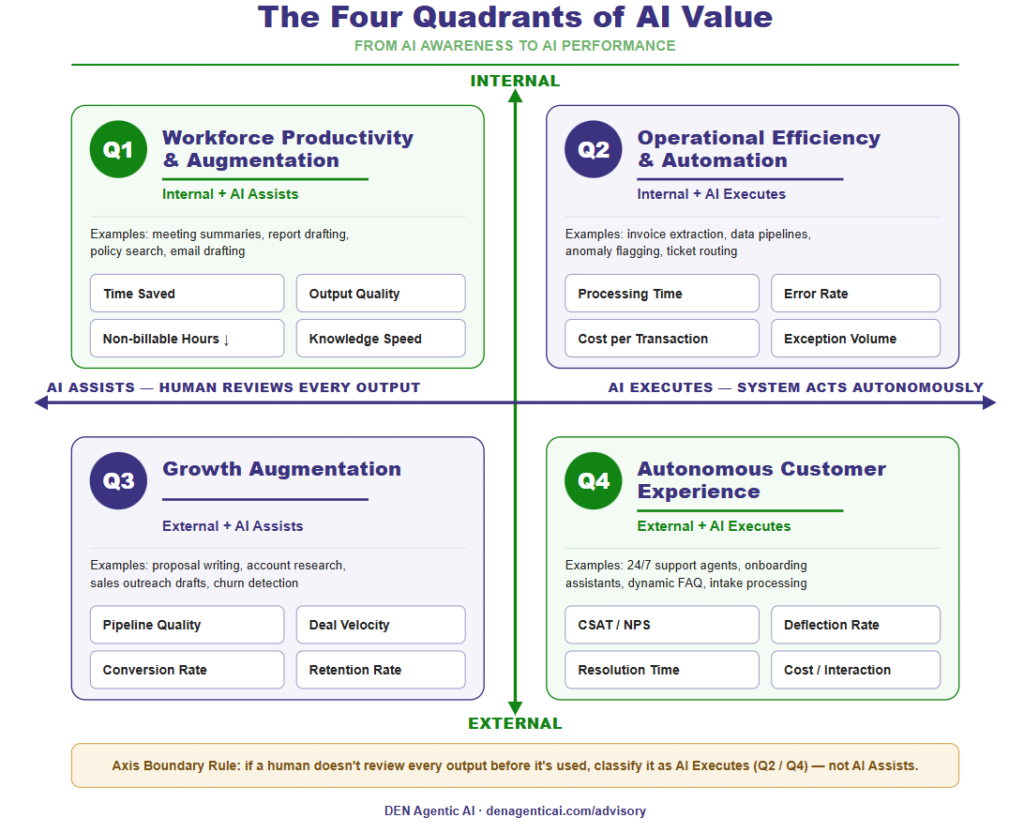
Q1 — Workforce Productivity & Augmentation (Internal · AI Assists)
Goal: Increase the speed and quality of individual employee outputs.
Examples: Meeting notes summaries, report drafting assistants, internal policy search tools, first-draft document generation, email drafting
Maturity Gate: Level 1+ — accessible to all organizations.
Governance: Basic self-review (Tier 1). The employee using the tool validates the output before action is taken.
Why to start here: Q1 initiatives build team AI literacy, establish prompting habits, and demonstrate value quickly — with minimal governance risk. Every organization should have at least two Q1 initiatives running before advancing to Q2.
Q2 — Operational Efficiency & Automation (Internal · AI Executes)
Goal: Reduce manual operational effort and transaction costs by automating internal processes.
Examples: Automated invoice data extraction, data transformation and cleaning pipelines, payroll anomaly flagging, ticket routing and triage, report generation from structured data
Maturity Gate: Level 2–3 — requires foundational data readiness and API-connected systems.
Governance: Checkpoint review (Tier 2). System performance is monitored via spot checks and automated validation rules. A supervisor reviews exceptions.
Key prerequisite: Read-write API access to the source system. Read-only APIs cannot push data back in — this kills most Q2 automations before they start.
Q3 — Growth Augmentation (External · AI Assists)
Goal: Drive top-line growth by assisting sales, marketing, and commercial teams.
Examples: AI-assisted proposal writing, account prioritization research, personalized sales outreach drafts, churn risk detection, client brief analysis
Maturity Gate: Level 3+ — requires structured data and an active governance policy with output review standards.
Governance: Supervisor and brand review (Tier 2/3). All external communications drafted by AI must be reviewed by a human before sending.
Note on naming: This quadrant is named “Growth Augmentation” (not “Revenue Generation”) to emphasize that AI’s commercial role is augmenting human sales professionals — not replacing human-led relationship management.
Q4 — Autonomous Customer Experience (External · AI Executes)
Goal: Improve the speed, scalability, and availability of client-facing services.
Examples: 24/7 client-facing support agents, automated onboarding assistants, dynamic FAQ systems, AI-mediated intake processing
Maturity Gate: Level 4+ — requires high maturity, measured ROI history, robust testing protocols, and full legal review.
Governance: Maximum oversight (Tier 3). Requires continuous compliance audits, fallback loops, and real-time failure escalation paths.
Warning: Q4 is the highest-risk quadrant for mid-market organizations. A single governance gap or data quality failure in a Q4 deployment becomes a customer-facing incident. Organizations should not attempt Q4 initiatives until Q1 and Q2 are proven operational.
The Governance Asymmetry: The Axis Boundary Rule
The distinction between AI Assists and AI Executes is the most important line in AI governance. When classifying initiatives near the boundary, apply the Axis Boundary Rule:
If an initiative involves any degree of automated execution without a human checking every output — or if human review is exception-only rather than default — it must be classified under the higher-autonomy AI Executes quadrant (Q2 or Q4).
This prevents organizations from under-governing high-risk, automated systems by misclassifying them as simple co-pilots.
How to Use the Four Quadrants in Your AI Strategy
Step 1: List every AI idea or initiative your team has generated.
Step 2: For each initiative, answer: Who benefits (internal or external)? Does a human review every output before action, or does the system act autonomously?
Step 3: Classify each initiative into Q1, Q2, Q3, or Q4.
Step 4: Apply your maturity ceiling. If your organization is at Level 2, Q3 and Q4 initiatives are not eligible — regardless of their business value.
Step 5: Score eligible initiatives using the 6-Criterion Use Case Prioritisation Scorecard to rank and select your first pilot.
→ How to prioritize among your eligible AI use cases →
→ Assess your maturity ceiling before selecting initiatives →
→ Return to Hub 1: The Complete Guide to AI Strategy →
Frequently Asked Questions
Q: What are the Four Quadrants of AI Value? The Four Quadrants of AI Value classify AI initiatives by two axes: who experiences the value (Internal vs. External) and how much autonomy the AI operates with (AI Assists vs. AI Executes). This produces four quadrants: Q1 Workforce Productivity, Q2 Operational Efficiency, Q3 Growth Augmentation, and Q4 Autonomous Customer Experience.
Q: What does “AI Executes” mean compared to “AI Assists”? “AI Assists” means the human reviews and approves every single output before it is used or sent. “AI Executes” means the system acts automatically — sending an email, routing a record, or executing a task — without a human checking each instance first.
Q: Can a Level 1 organization deploy a Q4 customer chatbot? No. A Level 1 organization lacks the data readiness, testing protocols, and governance infrastructure to manage an autonomous customer-facing system safely. Attempting to skip phases is the most common cause of high-profile AI failures in mid-market organizations.
Q: Which quadrant should a mid-market organization start with? Q1 — Workforce Productivity. These initiatives have the lowest risk, fastest adoption, and broadest accessibility. Starting in Q1 builds the team capability and governance habits needed to advance to Q2 automation.
Q: Why is Q3 named “Growth Augmentation” rather than “Revenue Generation”? To clarify AI’s actual role in commercial workflows: AI assists human sales and marketing professionals in being more effective — it does not replace human relationship management. The name “Growth Augmentation” reflects this accurately.
Written by Tariq Alam, Founder of DEN Agentic AI. Take the free AI Readiness Check at denagenticai.com//ai-capability-maturity-assessment. Score your use cases at denagenticai.com/use-case-scorer