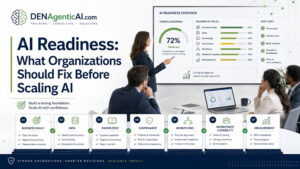

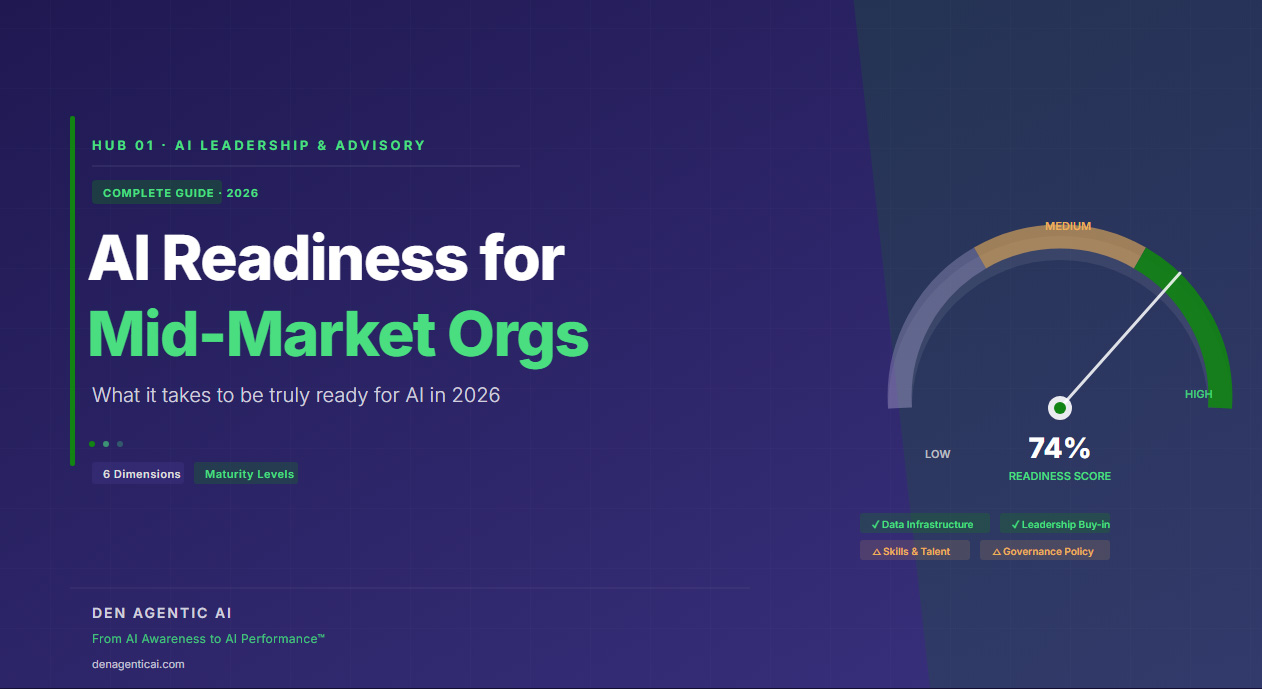
AI readiness is a measure of how well an organization’s strategy, data, technology, people, governance, and workflow connectivity are positioned to successfully deploy and benefit from artificial intelligence. For mid-market organizations — those with 50 to 500 employees — AI readiness is the single most important factor in determining whether AI initiatives succeed or fail.
This guide explains what AI readiness means in practice, how to measure it across six dimensions, and what to do about the gaps you find.
What Is AI Readiness — and Why Does It Matter?
AI readiness is the state of organizational preparedness across the systems, people, data, and governance structures that determine whether an AI initiative will succeed.
The distinction matters because most AI adoption failures are not technology failures. They are readiness failures. An organization deploys a capable AI tool into an environment that cannot support it — and the tool underperforms, adoption stalls, or a governance incident creates a costly setback.
Research from McKinsey, Deloitte, Gartner, and Accenture all arrived at the same conclusion: the primary predictor of AI adoption success is organizational maturity, not tool selection.
A Level 1 organization using a Level 4 AI tool does not become Level 4. It becomes Level 1 with an expensive, underused deployment — and a leadership team that is now skeptical of AI entirely.
The 6 Dimensions of AI Readiness
AI readiness is not a single score. It is a profile across six organizational dimensions, each of which can independently limit — or “ceiling” — the success of AI initiatives.
Dimension 1: AI Strategy
What it measures: Whether your organization has a written AI direction, a named person accountable for AI decisions, and at least one funded, approved AI initiative.
Level 1 indicators: AI is “being discussed” at a leadership level but no owner has been named, no budget has been allocated, and no initiative has been formally approved.
Why it matters: Without strategic clarity, every AI initiative competes with other priorities and lacks executive sponsorship when resistance emerges.
Dimension 2: AI-Ready Data
What it measures: Whether the data your AI systems need is clean, consistent, accessible, and in a structured format that AI tools can process.
Level 1 indicators: Data sits across disconnected spreadsheets, email threads, and siloed systems. There is no central data dictionary or data owner.
Why it matters: Gartner’s AI research consistently identifies poor data quality as the #1 technical cause of AI implementation failure.
Dimension 3: People & Capability
What it measures: Whether your team has the AI literacy to use tools deliberately — writing effective prompts, verifying outputs, and identifying where AI can and cannot be applied reliably.
Level 1 indicators: One or two individuals experiment with AI tools independently. No shared prompting framework exists. Most staff either avoid AI tools or use them without systematic verification.
Why it matters: AI literacy is a risk control, not just a productivity upgrade. Without it, teams cannot identify when AI outputs are wrong.
Dimension 4: Governance & Risk
What it measures: Whether your organization has a written AI use policy, an approved tools register, a named AI Governance Owner, and a defined process for reviewing AI outputs before they reach clients.
Level 1 indicators: No written policy. No approved tools list. Employees make their own data handling judgments. No incident reporting path exists.
Why it matters: This is the most common ceiling for mid-market organizations. Without governance, every other AI initiative operates at elevated risk.
→ How to build an AI governance framework →
Dimension 5: Tools & Technology
What it measures: Whether your technology infrastructure — cloud systems, database accessibility, and integration endpoints — supports secure, structured AI deployment.
Level 1 indicators: Legacy or on-premise systems with no cloud database. Systems operate in silos; data export is manual. No API integrations are active.
Why it matters: Off-the-shelf AI tools require secure cloud access to your business systems to retrieve context. Without modern API infrastructure, systems cannot integrate AI components.
Dimension 6: Automation Readiness
What it measures: Whether your business tools have read-write API access and your team has experience with workflow automation to support event-triggered AI workflows.
Level 1 indicators: Systems do not connect via API. Data is moved manually. No team member has experience with automated workflows or trigger-action sequencing tools.
Why it matters: Automated AI operations (Q2 and Q4 initiatives) require trigger events to route data automatically. If systems lack read-write APIs, AI cannot execute actions autonomously.
Why Mid-Market Organizations Face Unique Challenges
Mid-market organizations operate between two realities:
No dedicated AI team. The COO or IT Director is also the AI decision-maker, alongside their primary responsibilities.
Budget constraints. Enterprise-grade implementation projects are not available. Every dollar needs justification.
Vendor pressure without guidance. Software vendors aggressively pitch AI features without helping buyers understand whether their organization is ready to use those features.
No peer benchmarking. Unlike enterprise leaders who attend AI councils, mid-market leaders typically lack a peer community actively discussing AI readiness at their scale.
The result, documented consistently in 2026 research: organizations feel pressure to “do something with AI,” a tool is purchased, adoption is inconsistent, no one knows whether the investment worked, and leadership becomes cautious about the next initiative.
This cycle is entirely avoidable — but only with a structured readiness approach before deployment.
The 5 Most Common AI Readiness Gaps in Mid-Market Organizations
Gap 1: No Named AI Governance Owner. Every AI initiative raises questions someone needs to answer. Without a named owner, these questions are answered inconsistently or avoided entirely.
Gap 2: Data Accessibility Without Data Cleanliness. Many organizations have data — but it is in the wrong format, across the wrong systems, or riddled with inconsistencies that AI tools cannot reliably process.
Gap 3: Individual AI Use Without Shared Standards. Two or three team members using ChatGPT individually is not an AI strategy. It is a collection of personal productivity experiments with inconsistent quality and no institutional learning.
Gap 4: Read-Only APIs Misunderstood as Integration-Ready. Many organizations believe their tools “have an API” and are therefore automation-ready. Read-only APIs can pull data out — they cannot push data back in. Most automation workflows require read-write.
Gap 5: Governance Planned for “After the Pilot.” Governance is frequently scheduled as Phase 2 — something to formalize once the pilot is running. This sequencing is backwards. A pilot running without governance is a governance incident waiting to happen.
How to Assess Your AI Readiness
Option 1 — The Free AI Readiness Check (3 minutes): A question-based self-assessment that produces an instant score across all 6 dimensions with your ceiling dimension identified.
→ Take the Free AI Readiness Check →
Option 2 — The Free Governance Assessment (5 minutes): Specifically maps your governance readiness — the most frequently identified ceiling dimension — and produces a gap analysis against the 4 minimum viable governance elements.
→ Take the Governance Assessment →
Option 3 — Facilitated Assessment (Full): A structured 60–90 minute session applying the AI Capability Maturity Model across all six dimensions, producing a written AI Maturity Diagnostic Report.
→ How to conduct a full AI readiness assessment →
→ Return to Hub 1: The Complete Guide to AI Strategy →
Frequently Asked Questions
Q: What is AI readiness? AI readiness is the state of organizational preparedness across six dimensions — AI Strategy, AI-Ready Data, People & Capability, Governance & Risk, Tools & Technology, and Automation Readiness — that determine whether AI initiatives will succeed. It is measured as a profile, not a single score.
Q: How do mid-market organizations start with AI? Start with a readiness assessment to identify your maturity level and ceiling dimension. Then deploy Q1 AI Assist initiatives (internal, human-reviewed tools) while building the governance foundation. Do not begin automation or customer-facing AI until governance and data readiness are established.
Q: Which dimension is the most common AI readiness gap? Governance & Risk is the most consistently identified ceiling dimension in mid-market AI readiness assessments. Most organizations at Level 1 or Level 2 lack a written AI use policy, a named governance owner, or an approved tools register.
Q: What is the difference between AI readiness and AI maturity? AI readiness describes your current state across the six dimensions. AI maturity (Level 0–5) is the summary classification of that state. Both are produced by the same assessment process — the maturity level is derived from the lowest-scoring dimension in the readiness profile.
Written by Tariq Alam, Founder of DEN Agentic AI. Take the free AI Readiness Check at denagenticai.com/ai-readiness-check