
Services AI Workflow Automation
AI Workflow Automation

Reduce manual work with automation your team can manage

Connect work across your systems and teams. Combine reliable rules, AI assistance and human review where judgment or accountability is needed.

Why this matters

The challenge

People copy information between systems, chase approvals and repeat the same email and document tasks. Exceptions create rework, and existing automations become difficult to maintain when credentials, rules or application interfaces change.

A practical response

Our solution

We examine the process, simplify unnecessary steps and decide which parts need rules, AI or human judgment. Then we build a bounded workflow or assistant with visible responsibilities, exception handling and controls for important actions.

Workflow and agent design, build and operational handover

What we do

Map and improve the process

Document triggers, inputs, decisions, handoffs, volumes and exceptions. Record baseline cycle time, quality and handling effort.

Validate integration feasibility

Verify the exact API operations, authentication, permissions, payloads, limits and ownership needed by the workflow.

Design workflows, assistants and agents

Specify rules, extraction, classification, retrieval, prompts and tool permissions. Define which actions the system may take and when it must ask for approval.

Design oversight and recovery

Build in escalation, fallback, safe stopping, duplicate prevention and recovery. Name the people who handle exceptions and incidents.

Build and test

Implement the agreed integrations and logic. Test representative inputs, invalid model output, failed calls, permissions and recovery paths.

Deploy and prepare operators

Configure monitoring and cost controls, train users and operators, provide runbooks and stabilize the agreed release.

Illustrative applications

Examples of work we can help improve

Invoice handling

Extract fields, validate supplier information, route exceptions and prepare approved transactions with reconciliation and duplicate checks.

Knowledge and business assistants

Answer scoped employee or business questions using approved information, tested retrieval and explicit action boundaries.

Customer request routing

Classify requests, draft responses and escalate cases according to urgency, confidence and permitted actions.

Illustrative applications, not client results. The appropriate design depends on integration evidence, information fitness and consequences.

From scope to acceptance

How it works

  1. Choose a bounded process

    Agree the problem, baseline, owner and permitted actions.

  2. Approve the design

    Validate integrations, information needs, controls, costs and acceptance tests.

  3. Build and pilot

    Test controlled volumes with agreed oversight and a clear fallback.

  4. Release and hand over

    Confirm release evidence, prepare operators and transfer maintenance.

Deliverables matched to scope

What you receive

  • Current and proposed process maps
  • Integration assessment and approved workflow specification
  • Working workflow or assistant with agreed prompts, code and connections
  • Approval, exception and recovery controls with test evidence
  • Monitoring, operating runbooks and user or operator handover

Who this is for

Operations and IT teams improving work across email, documents, business applications, approvals and customer or employee assistance.

The build covers the agreed process and integrations. Broad source remediation belongs in a defined data-foundation workstream. Design funding, pilot approval, production release and expanded autonomy are separate decisions; ongoing operation requires an explicit agreement.

Evidence over assumptions

How we assess success

Compare cycle time, manual handling, rework, exception queues and cost per correctly completed case with the baseline. Include human review, maintenance and failures in the economics.

Before you start

Common questions

Does every workflow need an AI agent?

No. Use rules for stable steps and AI where interpretation adds value. Keep human review where consequences, uncertainty or accountability require it.

Can you build a knowledge assistant?

Yes, as a bounded implementation with agreed sources, permissions, retrieval, evaluation and handover. Shared information cleanup can be scoped through Data Foundations.

How do you choose a platform?

We assess integration fit, information protection, hosting, operating cost and the ability of your team to maintain it. Delivery may use low-code tools, code or a combination.

Continue from here

Related services

Let’s talk

Find a practical starting point

Tell us about a business question, a stalled initiative, a manual process or a capability gap. We will help identify the next useful step.

LATEST Posts

calculate-ai-roi

How to Calculate AI ROI: A Realistic Framework That CFOs Will Believe

The most common reason AI business cases fail CFO review is not that the opportunity is small. It’s that the …
How-to-build-90-Day AI Roadmap

How to Build a 90-Day AI Roadmap: A Step-by-Step Guide for Mid-Market Leaders

A 90-day AI roadmap is a structured plan that sequences your organization’s AI initiatives across the first quarter of deliberate …
Prioritize-AI-Use-cases

How to Prioritize AI Use Cases: A 6-Criterion Scorecard for Operations Leaders

AI use case prioritization is the structured process of evaluating and ranking potential AI initiatives before committing resources — ensuring …
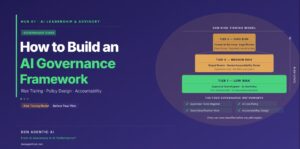
AI-governance-framework

How to Build an AI Governance Framework: The Mid-Market Guide

Most mid-market organizations discover they need an AI governance framework the same way: something goes wrong. An employee submits a …
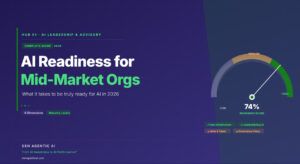
AI-Readiness

AI Readiness for Mid-Market Organizations: The Complete 2026 Guide

AI readiness is a measure of how well an organization’s strategy, data, technology, people, governance, and workflow connectivity are positioned …
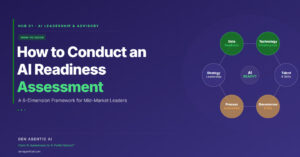
AI-Readiness-Conduct

How to Conduct an AI Readiness Assessment: A 6-Dimension Framework

An AI readiness assessment is a structured evaluation of an organization’s current capability across the six dimensions that determine whether …