
Give your AI investment a clear direction
Identify where AI can create useful business value and what must be in place to deliver it. Compare opportunities, assess readiness and build an investment roadmap your team can act on.
The challenge
AI ideas compete for attention, but they need different data, controls, skills and investment. Without a clear method, organizations can fund pilots before understanding the prerequisites or how success will be measured.
Our solution
We use DEN’s Four Quadrants of AI Value to frame each opportunity, then assess its readiness, risk and economics using evidence. You receive a documented recommendation on what to pursue, prepare, redesign or defer.
What we do
Discover the work
Map tasks, delays, errors, knowledge gaps and commercial opportunities. Agree the business problem, accountable owner and current performance.
Classify the opportunity
Distinguish workforce assistance, operational automation, growth assistance and autonomous customer experiences. Split mixed use cases when permissions differ.
Assess six readiness dimensions
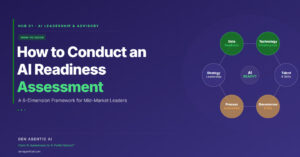
Examine strategy, AI-ready data, tools and technology, people and capability, governance and risk, and automation readiness against the intended use.
Design governance and responsible AI controls
Assess affected people, information sensitivity, action authority, oversight, security, potential harms and recovery. Define owners and approval responsibilities.
Build the investment case
Set KPIs and baselines, estimate full delivery and operating costs, and compare benefit scenarios. Separate capacity released, cash savings and attributable contribution margin.
Plan adoption and delivery
Specify role changes, training, prerequisites and phased decisions. Prioritize eligible opportunities and make blocked initiatives visible.
One framework. Evidence for each decision.
Q1 · Workforce Productivity
Help employees find, create, analyze or review information, with people accountable for using the output.
Q2 · Operational Efficiency
Automate bounded process steps across systems, with defined approvals, exceptions and recovery.
Q3 · Growth Augmentation
Support people in sales and customer-facing work while retaining human accountability for commitments.
Q4 · Autonomous Customer Experience
Complete defined customer interactions or actions within explicit permissions, with monitoring and human escalation.
Read left to right: assistance to execution. Read top to bottom: internal work to external-facing work.
Quadrant placement generates a starting assessment profile. It does not establish actual maturity, fix a risk tier or authorize a deployment.
How it works
Discover and classify
Agree the business need, candidate use cases and intended boundaries.
Assess the evidence
Review data, integration, capability and governance; identify blockers and risks.
Define the initiative
Agree controls, KPIs, costs, benefit scenarios and the adoption approach.
Agree the roadmap
Sequence work, assign owners and define the evidence for the next decision.
What you receive
- Classified and prioritized use-case portfolio
- Six-dimension readiness profile and owned gap backlog
- Risk findings, governance responsibilities and responsible AI controls
- Initiative profiles with KPIs, cost and benefit scenarios
- Adoption plan and an initial 90-day action roadmap
Who this is for
Executives, operations and transformation leaders with competing AI ideas, a stalled pilot, unclear governance or an investment decision to make.
A focused engagement delivers the relevant subset of these outputs. Technical builds, broad data remediation, pilot oversight and ongoing support are separately scoped.
How we assess success
You can explain why an initiative was selected, what supports the decision, what must change first, who owns the outcome and what evidence is needed next.
Common questions
Does the quadrant determine maturity or risk?
It supplies a starting assessment profile. Actual readiness and risk depend on the data, permissions, consequences and operating context. Quadrant placement does not authorize deployment.
Can we start with a stalled pilot?
Yes. We can identify blockers and recommend remediation, a narrower scope, further evidence or a stop decision.
Is the introductory conversation a full assessment?
The introductory conversation establishes fit and a useful next step. Detailed diagnostics, architecture and business cases are scoped paid work.
Find a practical starting point
Tell us about a business question, a stalled initiative, a manual process or a capability gap. We will help identify the next useful step.
LATEST Posts

How to Calculate AI ROI: A Realistic Framework That CFOs Will Believe

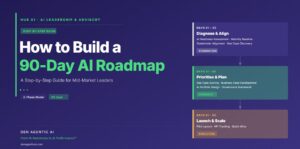
How to Build a 90-Day AI Roadmap: A Step-by-Step Guide for Mid-Market Leaders

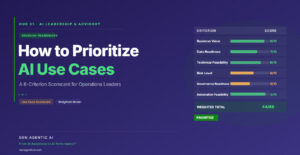
How to Prioritize AI Use Cases: A 6-Criterion Scorecard for Operations Leaders

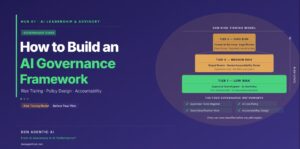
How to Build an AI Governance Framework: The Mid-Market Guide

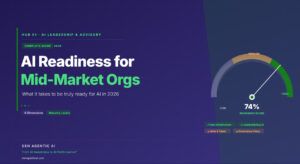
AI Readiness for Mid-Market Organizations: The Complete 2026 Guide