


The DEN approach

Turn AI ideas into informed investment decisions

Classify the opportunity, assess the evidence and agree the next step. Our approach connects business value with information, readiness, risk, economics and adoption.

Classify the opportunity

Four Quadrants of AI Value

Two questions frame the work: who benefits, and how much action authority will the AI have? Classify components separately when an initiative combines different audiences or permissions.

Internal work · AI assistance

Q1 · Workforce Productivity

Help employees find, create, analyze or review information, with people accountable for using the output.

Internal work · AI execution

Q2 · Operational Efficiency

Automate bounded process steps across systems, with defined approvals, exceptions and recovery.

External-facing work · AI assistance

Q3 · Growth Augmentation

Support people in sales and customer-facing work while retaining human accountability for commitments.

External-facing work · AI execution

Q4 · Autonomous Customer Experience

Complete defined customer interactions or actions within explicit permissions, with monitoring and human escalation.

Read left to right: assistance to execution. Read top to bottom: internal work to external-facing work.

The quadrants describe the use. An internal application can still involve sensitive data or consequential decisions. A quadrant is a starting point for assessment, not a risk certification.

Six readiness dimensions

Assess required capability against demonstrated readiness

AI Strategy

A defined objective, sponsor, accountable owner and investment rationale.

AI Ready Data

Information quality, relevance, definitions, freshness, access and ownership for the intended use.

Tools and Technology

Infrastructure, identity, integration and deployment capability.

People and Capability

Skills to use, verify, supervise and support the solution.

Governance and Risk

Approval authority, responsible AI controls, oversight and incident response.

AI Automation

Process stability, action boundaries, exception handling, recovery and operational ownership.

An unmet critical capability blocks the relevant deployment stage until the gap is resolved. Target capability and demonstrated evidence are recorded separately.

Measurement and investment

Define success and test the economics

Illustrative measurement and benefit profiles
QuadrantExample KPIsValue and cost considerations
Q1 · Workforce ProductivityTime per accepted task, rework, output quality and appropriate useNet time saved after review; distinguish released capacity from spending reductions.
Q2 · Operational EfficiencyCost per correct case, cycle time, exceptions and recovery successInclude integration, execution, operator handling and ongoing maintenance.
Q3 · Growth AugmentationConversion, sales-cycle length, quality of customer commitmentsUse attributable contribution margin; include review, training and experimentation costs.
Q4 · Autonomous Customer ExperienceSuccessful resolution, repeat contacts, escalation and harmful actionsInclude identity, monitoring, human support and cost per successfully resolved need.

Every initiative also needs baseline, adoption, quality and risk measures. Cost models include data preparation, build, evaluation, human oversight, learning and operation. Compare conservative, expected and optimistic scenarios.

Governance and responsible AI

Make risk and responsibility explicit

Assess consequences, affected people, information sensitivity, permissions, scale, reversibility and the ability to detect failure and intervene. Define privacy, security, reliability, fairness where relevant, transparency, accessibility and accountable human oversight.

A reviewer needs the expertise, time, information and authority to challenge an output. Bounded autonomous actions need explicit permissions, monitoring, safe stopping and escalation.

Stage-specific decisions

Make a decision at each stage

Discovery and design

Is the problem worth pursuing? Is the proposed approach credible enough to fund the next stage?

Controlled pilot

Are the boundaries, information, safeguards, baselines and measures sufficient for an approved trial?

Production and scale

Does evaluation and operating evidence support release? Do observed outcomes justify greater volume, scope or autonomy?

The outcome may be proceed, remediate, redesign, defer or stop. A new data source, audience, model or action permission can require reassessment.

Example decisions

What this looks like in practice

Internal policy assistant · Q1

Validate source ownership, document currency and permissions. Evaluate supported answers and measure time per accepted task. Defer wider rollout if restricted material can be retrieved.

Invoice workflow · Q2

Validate supplier records, transaction permissions and duplicate prevention. Pilot with approved transactions; compare total handling cost and require recovery evidence before production.

Proposal assistance · Q3

Use approved commercial information and review claims before release. Assess quality and incremental contribution margin with a credible comparison.

Customer order assistant · Q4

Verify identity, limit permitted actions and provide human escalation. Measure correct resolutions and repeat contacts. Defer a live pilot if access controls or safe recovery are unproven.

These are illustrative scenarios, not client case studies or promised outcomes.

Let’s talk

Build an assessed AI portfolio

Leave with a clear view of what to pursue, what needs preparation, what it could cost and how success will be judged.

LATEST Posts

calculate-ai-roi

How to Calculate AI ROI: A Realistic Framework That CFOs Will Believe

The most common reason AI business cases fail CFO review is not that the opportunity is small. It’s that the …
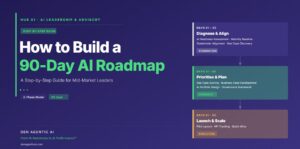
How-to-build-90-Day AI Roadmap

How to Build a 90-Day AI Roadmap: A Step-by-Step Guide for Mid-Market Leaders

A 90-day AI roadmap is a structured plan that sequences your organization’s AI initiatives across the first quarter of deliberate …
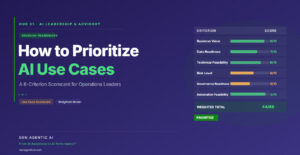
Prioritize-AI-Use-cases

How to Prioritize AI Use Cases: A 6-Criterion Scorecard for Operations Leaders

AI use case prioritization is the structured process of evaluating and ranking potential AI initiatives before committing resources — ensuring …
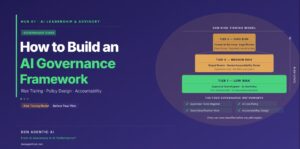
AI-governance-framework

How to Build an AI Governance Framework: The Mid-Market Guide

Most mid-market organizations discover they need an AI governance framework the same way: something goes wrong. An employee submits a …
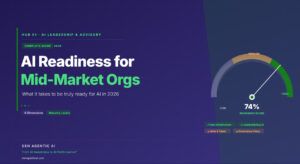
AI-Readiness

AI Readiness for Mid-Market Organizations: The Complete 2026 Guide

AI readiness is a measure of how well an organization’s strategy, data, technology, people, governance, and workflow connectivity are positioned …
AI-Readiness-Conduct

How to Conduct an AI Readiness Assessment: A 6-Dimension Framework

An AI readiness assessment is a structured evaluation of an organization’s current capability across the six dimensions that determine whether …