
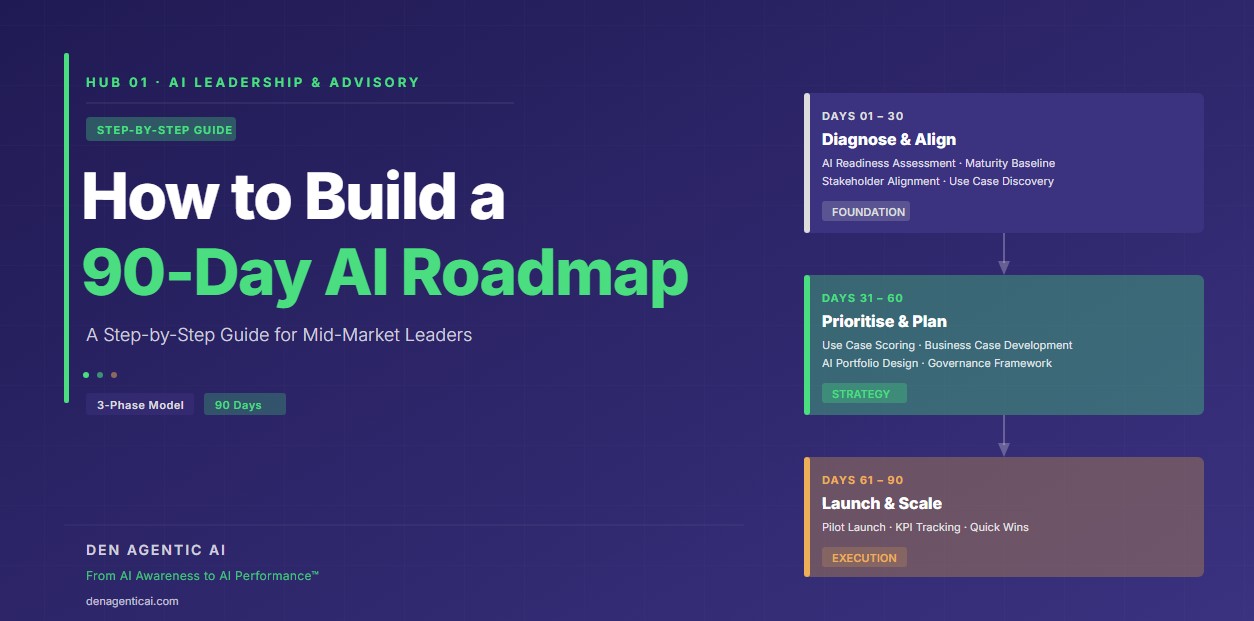
A 90-day AI roadmap is a structured plan that sequences your organization’s AI initiatives across the first quarter of deliberate AI adoption — covering governance milestones, use case selection, pilot design, resource allocation, and measurement frameworks. It is the document that moves AI from a leadership conversation to an operational programme.
This guide walks through the complete structure of a 90-day AI roadmap for a mid-market organization starting at Level 1 or Level 2 AI maturity.
Why 90 Days — And Why a Roadmap at All?
Why 90 days: Ninety days is the minimum meaningful cycle for AI initiative planning. It is long enough to complete a governance foundation and a full pilot cycle (30-day PoC + 60-day controlled pilot). It is short enough to maintain leadership engagement and produce visible results before attention drifts.
Why a roadmap: Without a sequenced plan, AI initiatives suffer from “initiative scatter” — multiple simultaneous experiments with no measurement framework, no sequencing logic, and no accountability structure. The roadmap replaces scatter with sequence.
The roadmap has one primary job: make the path from where your organization is today to a successful first AI deployment visible, sequenced, and measurable.
Before You Build the Roadmap: Two Prerequisites
The 90-day AI roadmap is not the first step in AI adoption. Two inputs are required before it can be built:
Input 1: Your AI Readiness Assessment You need to know your maturity level and ceiling dimension before you can sequence a path forward. The roadmap is structured differently for a Level 1 organization (governance-first path) than for a Level 2 organization (pilot-first with governance in parallel).
→ Take the free AI Readiness Check →
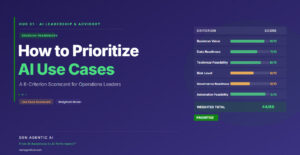
Input 2: Your Prioritized Use Case List You need at least 2–3 scored AI use case candidates before you can sequence which ones to pilot.
→ How to prioritize your AI use case candidates →
The 90-Day AI Roadmap: Phase Structure
Phase 1 — Weeks 1–4: Governance Foundation
Purpose: Close the governance gaps identified in your readiness assessment before any AI pilot begins.
Milestone 1.1: Name the AI Governance Owner (end of Week 1). Communicate the appointment to all staff. This is the single most important governance action.
Milestone 1.2: Publish the Approved Tools Register (end of Week 2). Audit current AI tool use via team survey. Classify each tool: Approved / Under Review / Suspended.
Milestone 1.3: Write and Communicate the Data Classification Rule (end of Week 2). One paragraph. Three to four restricted data categories.
Milestone 1.4: Implement the Three-Tier Output Review Policy (end of Week 3). Documented and communicated with tier examples.
Milestone 1.5: Confirm API Readiness for Top Use Case Candidate (end of Week 4). IT confirms source system API availability, read vs. read-write access, authentication method.
Checkpoint: At Week 4, the organization has minimum viable governance and confirmed technical feasibility for the first use case. Phase 2 is conditional on these milestones being met.
Phase 2 — Weeks 5–8: Proof of Concept
Purpose: Validate the technical assumption for the first use case in a controlled, minimal-scope environment.
PoC Design Principles:
- One use case. Not two. One.
- One team. 3–5 people. Not the whole organization.
- Bounded scope. Define the exact workflow, inputs, and expected outputs before Day 1.
- 30-day window. Hard stop at 30 days. The PoC answers one question: “Does the technical assumption hold?”
PoC Measurement Framework: Before the PoC begins, define three KPIs:
- Outcome KPI: The business metric the use case is intended to improve (baselined before Day 1)
- Process KPI: Confirms the AI tool is being used (e.g., % of target tasks where AI was used)
- Quality KPI: Confirms output quality is maintained (e.g., revision rate on AI drafts)
Gate 1 (Day 30): Compare actuals against projections. If actuals are within 80% of projections → proceed to Phase 3. If below 80% → assess root cause before committing Phase 3 resources.
Phase 3 — Weeks 9–12: Controlled Pilot
Purpose: Validate adoption and outcomes at a broader but still controlled scale — with full measurement.
Pilot Design:
- Expand from 1 team to 2–3 teams (or the full relevant function)
- Maintain the three defined KPIs
- Add a 30-day adoption measurement: what % of target staff are using the tool at target frequency?
Gate 2 (Week 12): Leadership makes one of three decisions:
- Stage 3 Production Approved: Pilot met KPI targets → proceed to organization-wide rollout
- Conditional Approval: Pilot showed promise but 1–2 gaps need resolution → 30-day extension with specific conditions
- Initiative Suspended: Actuals consistently missed projections → document learning, archive the initiative, redirect resources
The 8-Component Initiative Canvas
Every AI initiative in your roadmap must be documented using the Strategic AI Initiative Canvas — 8 components that ensure the initiative is fully specified before resources are committed:
- Business Problem Statement — with a specific number (not “we want to save time”)
- AI Application Design — step-by-step workflow with trigger, decision points, error paths
- Data Source & Quality — exact source system, access method, known quality issues
- Human Review Design — who reviews what, at which tier, by when
- Governance & Risk Tier — Tier 1, 2, or 3, and what that requires in practice
- KPI & Success Metrics — Outcome KPI + Process KPI + Quality KPI, all baselined
- Cost Envelope — Setup + Operations + Oversight + 20% contingency
- Pilot Scope — one team, bounded volume, 30-day go/no-go gate
If any of the 8 components cannot be completed before the PoC begins, the PoC is not ready to start. Incomplete specification is the leading cause of AI pilot failure.
→ Download the Strategic AI Initiative Canvas (free PDF) →
The 90-Day Roadmap at a Glance
| Week | Phase | Key Actions |
|---|---|---|
| 1 | Governance | Name AI Governance Owner; communicate to team |
| 2 | Governance | Publish Approved Tools Register; write Data Classification Rule |
| 3 | Governance | Implement Three-Tier Output Review Policy |
| 4 | Governance | Confirm API readiness; complete Initiative Canvas for Use Case #1 |
| 5 | PoC | Launch PoC with one team; baseline KPIs measured Day 1 |
| 6–7 | PoC | Weekly KPI check-ins; address adoption and technical issues |
| 8 | PoC | Gate 1 decision: proceed, adjust, or pause |
| 9 | Pilot | Expand to 2–3 teams; maintain measurement framework |
| 10–11 | Pilot | Bi-weekly adoption reviews; address resistance and quality gaps |
| 12 | Pilot | Gate 2 decision: Deploy / Extend / Suspend |
What Comes After 90 Days?
A successful 90-day roadmap moves your first AI initiative through Stage 1 (PoC) and Stage 2 (Controlled Pilot), producing two outcomes:
- A validated first AI initiative: In daily operational use with real adoption and quality metrics, ready for Stage 3 (Production Deployment)
- An organizational learning baseline: Your team has direct experience with AI deployment, output validation, and policy compliance — raising your baseline maturity
→ Learn how to calculate the ROI for your roadmap initiatives →
→ See how to prioritize which use cases go into your roadmap →
→ Return to Hub 1: The Complete Guide to AI Strategy →
Frequently Asked Questions
Q: How do I create an AI roadmap for my business? Build a 90-day AI roadmap covering three phases: Phase 1 (Weeks 1–4: Governance Foundation), Phase 2 (Weeks 5–8: Proof of Concept), and Phase 3 (Weeks 9–12: Controlled Pilot). Measure performance against outcome, process, and quality KPIs before deciding to scale.
Q: What should an AI implementation plan include? A governance milestone schedule, a prioritized use case list with scoring rationale, a pilot design for the first initiative (scope, team, timeline, KPIs), a budget structured around a 3-gate model, and a decision framework for each gate.
Q: How long does it take to implement AI in a mid-market organization? Establishing governance: 4 weeks. A Stage 1 PoC: 4 weeks. A Stage 2 controlled pilot: 4 weeks. A successful first pilot deployment: 90 days. Scaling to production (Stage 3): an additional 3–6 months.
Q: Should AI governance come before or after the first AI pilot? Always before. Running a pilot without minimum viable governance — a named owner, a tools register, a data classification rule — creates avoidable risk. The governance foundation is Phase 1 of the roadmap, not Phase 2.
Q: What is the 4-Stage-Gate investment model for AI? A model that structures AI investment across four gates: Stage 1 (PoC validates technical assumptions), Stage 2 (Controlled Pilot validates adoption and ROI), Stage 3 (Production scales to all target users), Stage 4 (Scale & Extend applies capabilities to adjacent use cases). Each stage triggers investment only on validated results.
Written by Tariq Alam, Founder of DEN Agentic AI. Download the free Strategic AI Initiative Canvas at denagenticai.com/resources. Book a free consultation at denagenticai.com/ai-readiness-consultation