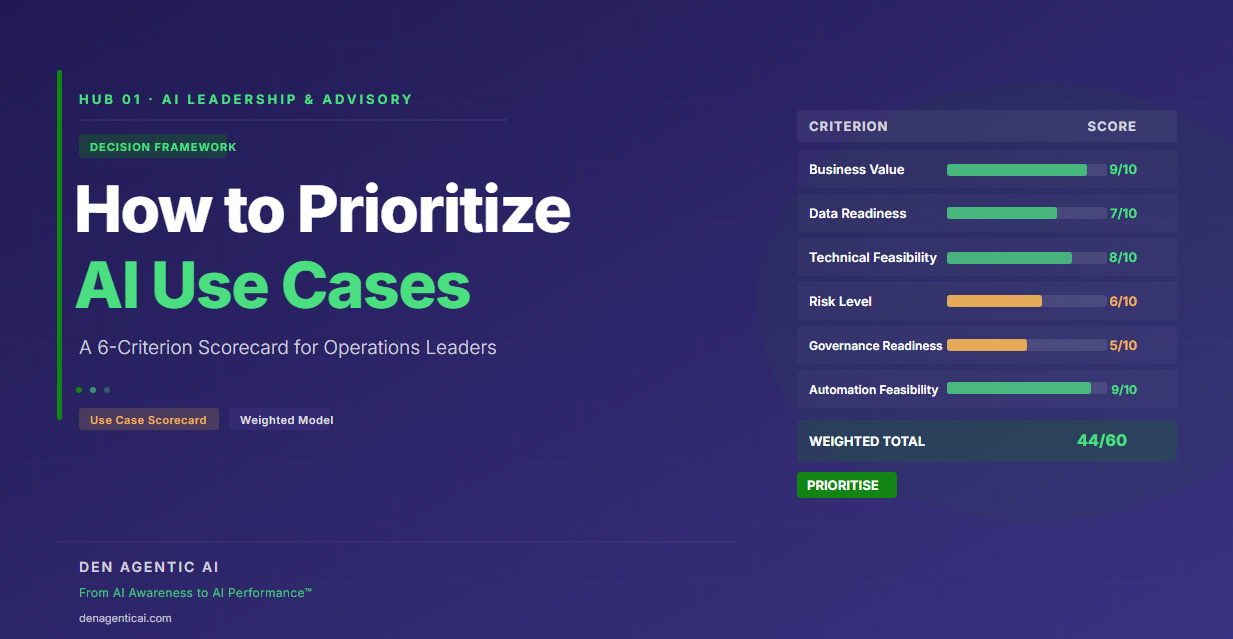
AI use case prioritization is the structured process of evaluating and ranking potential AI initiatives before committing resources — ensuring that the initiatives you choose are the right match for your organization’s current maturity level, governance readiness, and available data.
Most organizations skip this step. They identify an AI opportunity — often through vendor demo, board suggestion, or competitor observation — and move directly to evaluation or purchase. The result is a predictable pattern: pilots that stall, automations that fail in deployment, and leadership teams that conclude AI isn’t working for their business.
The initiatives weren’t necessarily wrong. The selection process was.
Why Prioritization Is the Highest-Value AI Strategy Activity
McKinsey’s 2026 AI research identified a consistent pattern across successful mid-market AI adopters: every successful deployment was preceded by a deliberate use case selection process. The organizations that skipped straight to tool selection had significantly higher pilot failure rates.
The reason is structural. AI initiatives fail in predictable ways:
- The data required was not clean or accessible
- The governance framework didn’t cover the risk tier of the initiative
- The technical integration turned out to be impossible with the existing tool stack
- The ROI case was built on optimistic assumptions that didn’t survive contact with reality
A prioritization scorecard surfaces all of these failure modes before investment is made — not after deployment disappoints.
Step 1: Discover the Candidates
Before you can prioritize, you need a pool of genuine AI candidates. The most reliable discovery method is structured internal research — not vendor demos.
The Four Friction Lenses:
Lens 1 — Time Drain: Which tasks consume the most time without proportionate value? (Target: tasks consuming more than 3 hours/week per person or more than 10 hours/week team-wide)
Lens 2 — Error & Exception: Where do mistakes happen most often? Which tasks get redone regularly because the first output was wrong?
Lens 3 — Knowledge Access: Where does your team spend time finding information they should already have instantly? (Research, precedent searches, policy lookups)
Lens 4 — Commercial Opportunity: Where could speed or quality improvements directly affect revenue, retention, or client satisfaction?
Run these four lenses through a 90-minute session with your operational team. Aim to surface 8–12 task candidates. Then classify each:
- Deterministic (same steps every time) → Automation candidate (Q2)
- Heuristic (requires judgment) → AI Assist candidate (Q1)
- Complex multi-step (retrieval + synthesis + decision) → Agentic AI candidate
→ Try the free Use Case Prioritisation Scorer →
Step 2: Score Each Candidate — The 5-Criterion Weighted Scorecard
Score each candidate on a 1–5 scale across five criteria, then apply the weights:
Criterion 1: Business Value — 30% Weight
What it measures: Impact on revenue growth, operational cost reduction, work quality, or customer experience.
- 5: Direct impact on revenue (>5% growth) or cost reduction (>10 hours/week saved team-wide)
- 3: Meaningful operational improvement with moderate, measurable impact
- 1: Minor convenience improvement with minimal measurable impact
Criterion 2: Data Readiness — 25% Weight
What it measures: The availability, accessibility, and quality of the data or knowledge required.
- 5: Structured, clean data exists in a centralized warehouse; documents are version-controlled and current
- 3: Data is accessible but has known quality issues or sits in separate systems; cleanup is required
- 1: Data is scattered across email threads or legacy systems with no API access
Criterion 3: Technical Feasibility — 20% Weight
What it measures: The ease of implementation given your current tech stack and technical capabilities.
- 5: Off-the-shelf software with pre-built connectors; no custom development required
- 3: Standard APIs exist, but moderate integration configuration is required
- 1: Requires custom ML development or integration with legacy systems lacking APIs
Criterion 4: Risk Level (Inverted) — 15% Weight ⚠️ SUBJECT TO MANDATORY FLOOR RULE
What it measures: The severity of consequences if the AI system makes a critical error. Higher score = lower risk.
- 5: Very low risk. Internal use only, easily reversible, zero client or compliance exposure
- 3: Moderate risk. Output is customer-visible but reviewed by staff before acting
- 1: High risk. System executes client-facing communications autonomously or influences legal/financial decisions
Criterion 5: Governance Readiness — 10% Weight ⚠️ SUBJECT TO MANDATORY FLOOR RULE
What it measures: Whether your current governance policies can manage the risk tier of this initiative.
- 5: Full governance in place: written use policy, approved tools list, named owner, tiered output review
- 3: Partial governance policy exists, but review habits and escalation trails are not yet standardized
- 1: No governance policy or approved tools list exists
Step 3: Apply the Mandatory Floor Rule and Rank
⚠️ Mandatory Floor Rule: Any initiative scoring a 1 on Risk Level or a 1 on Governance Readiness is immediately eliminated from consideration — regardless of its business value score. A high-value initiative with inadequate governance is a high-value failure.
For initiatives that pass the floor rule, calculate the weighted score:
Weighted Score = (Business Value × 0.30) + (Data Readiness × 0.25) + (Technical Feasibility × 0.20) + (Risk Level × 0.15) + (Governance Readiness × 0.10)
Rank all eligible initiatives by weighted score (maximum: 5.0). The top 2–3 become your roadmap pipeline.
Matching Initiatives to the Four Quadrants
Once classified, every initiative maps to one of the Four Quadrants of AI Value:
- Q1 — Workforce Productivity (Internal + AI Assists): AI drafting, summarizing, researching. Eligible at Level 1+ maturity.
- Q2 — Operational Efficiency (Internal + AI Executes): Automated internal workflows. Requires Level 2–3 maturity and API-connected systems.
- Q3 — Growth Augmentation (External + AI Assists): AI embedded in client-facing work. Requires Level 3 maturity.
- Q4 — Autonomous Customer Experience (External + AI Executes): AI interacts directly with external stakeholders. Requires Level 4 maturity and full legal review.
The most common prioritization mistake is selecting Q4 initiatives when operating at Level 1 or 2 maturity. Start in Q1, build governance to unlock Q2, then sequence external deployments only after internal capability is proven.
→ Deep dive: The Four Quadrants of AI Value →
After Prioritization: Build the Business Case and Roadmap
Once your top initiative is identified, two next steps follow immediately:
- Calculate ROI — before committing budget, model the realistic return accounting for oversight costs, adoption curves, and error rates → How to calculate AI ROI →
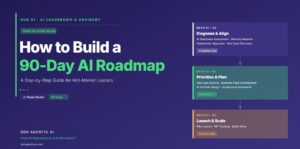
- Build the 90-Day Roadmap — sequence your governance foundation, PoC, and controlled pilot phases with defined gate decisions → How to build a 90-day AI roadmap →
→ Return to Hub 1: The Complete Guide to AI Strategy →
Frequently Asked Questions
Q: How do you prioritize AI use cases? Score each candidate against five weighted criteria: Business Value (30%), Data Readiness (25%), Technical Feasibility (20%), Risk Level (15%), and Governance Readiness (10%). Any use case scoring 1 on Risk or Governance is automatically eliminated. Rank remaining candidates by weighted score and select the top 2–3 for your roadmap.
Q: Which AI use cases should a mid-market organization start with? Start with Q1 AI Assist initiatives — internal, human-reviewed, low-risk applications like report drafting, meeting summarization, internal knowledge search, and proposal drafting. These build team capability and governance experience before moving to automation (Q2).
Q: What is the biggest mistake organizations make when selecting AI use cases? Selecting initiatives based on excitement or competitive pressure rather than organizational readiness — specifically, attempting Q4 (autonomous customer-facing) use cases when the organization is at Level 1 maturity with no governance framework.
Q: How many AI use cases should an organization pilot at once? For Level 1 or Level 2 organizations: one to two Q1 initiatives simultaneously. Piloting too many at once diffuses attention, makes measurement unreliable, and stretches governance oversight beyond what an early-stage framework can manage.
Q: What is the difference between an AI use case and an AI automation? An AI use case is any business application of AI — this includes both AI Assist (human reviews output) and AI automation (AI executes without per-instance human review). Automation is a specific, higher-governance subset of AI use cases requiring deterministic workflows and API integration.
Written by Tariq Alam, Founder of DEN Agentic AI. Try the free Use Case Prioritisation Scorer at denagenticai.com/use-case-scorer. Free prioritization tools at denagenticai.com/resources